
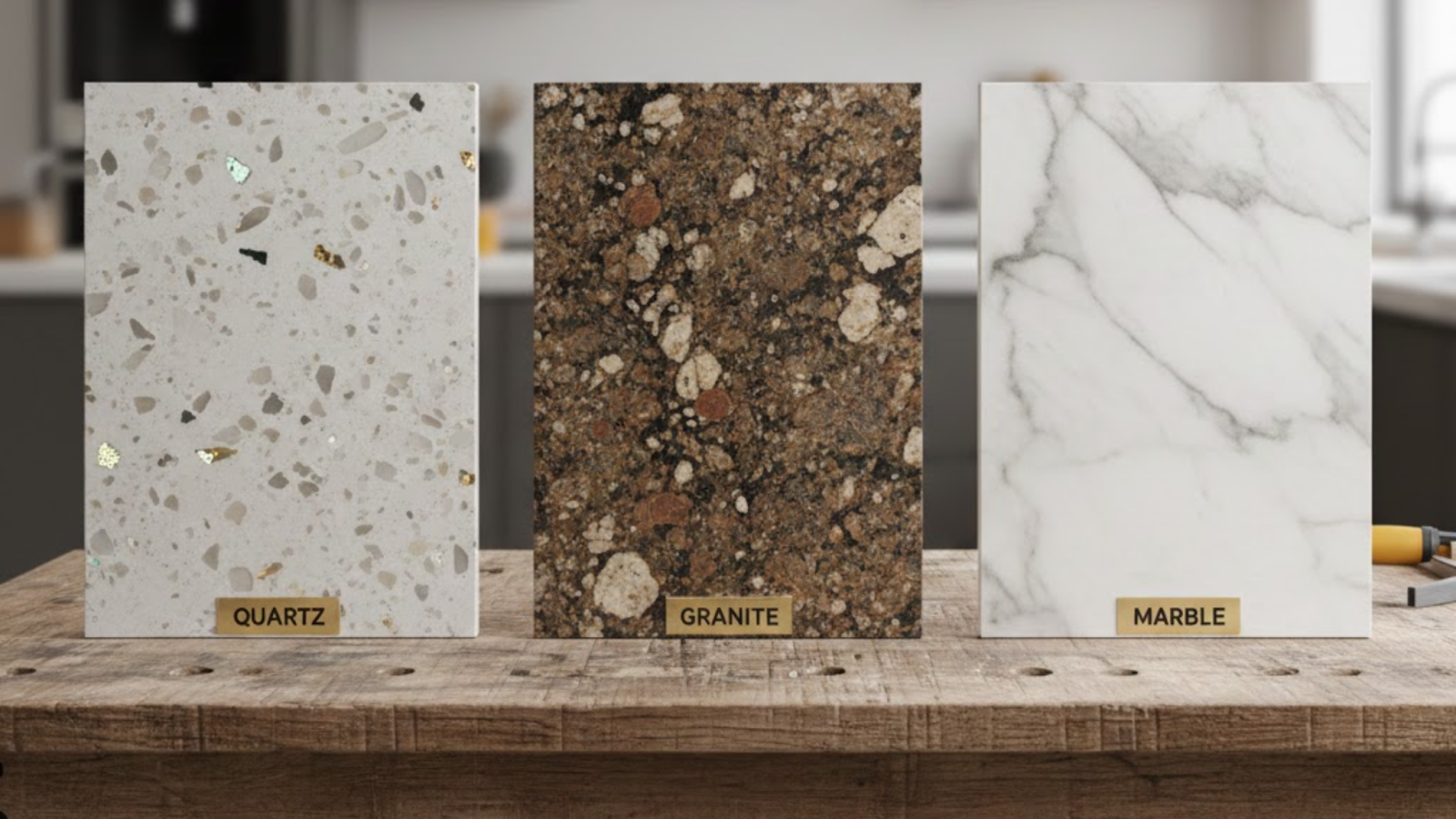
Selecting an appropriate marble surface is a serious choice to make and this is particularly in cases where your interest is durability, longevity, and practicality in daily life. Although all materials possess advantages and disadvantages, when it comes to deciding between quartz, granite and marble, homeowners usually seek information on the main differences between these materials to select the final choice.
By knowing these requirements, you will not only get a countertop that matches your interior but also one that will resist the needs of the day-to-day.
Understanding the Nature of Each Stone
To compare performance and durability, it is always useful to discuss the differences between such materials before making comparisons on performance and durability.
- Granite is a natural igneous rock which is appreciated due to its density and mineral composition.
- Marble, often seen in luxury interiors and widely popular in regions such as marble Cardiff installations, is a metamorphic stone known for its veining and soft elegance.
- Quartz is also produced by mixing crushed natural quartz with resins, which gives it a controlled and uniform finish.
These essential differences contribute significantly to the most important differences between quartz, granite, and marble, particularly when considering long-term durability.
Durability Comparison Between Granite vs Marble vs Quartz
Stone surfaces are made more durable when homeowners are interested in long-term values and limited maintenance. Although each of the materials displays its advantages, their resistance to heat, impact, stains, and normal wear and tear differs greatly.
Knowing these factors will assist you in weighing the main differences between quartz, granite and marble with more confidence before making the final choice. The main durability properties of both materials are as follows:
Granite
When evaluating granite vs marble, granite worktops often stand out as the stronger and more resilient option. It is a naturally hard material, and scratches, chips, and everyday kitchen accidents can be easily ignored. Heat tolerance is one of its most cherished properties; even a hot dish or pot set on granite rarely gets damaged.
Granite is even more practical with sealing. It offers a well-sealed surface that prevents the penetration of stains, bacteria, and moisture, which is ideal in high-activity kitchens. This consistent work is among the reasons why many residential owners perceive granite as the standard of stone surfaces that last a long time.
Marble
Marble is also linked to eternal beauty. It is popular in classical and modern interiors, where its veining, changeability, and fine finish are highly valued. Other installations, like marble Ardiff kitchens, show exactly how transformative marble can be aesthetically.
While marble worktop is a relatively soft stone compared to granite, it does require a little care—primarily because of the softer minerals, which make it more susceptible to additional abrasion, as well as to etching that commonly results from spills of acidic liquids such as vinegar, citrus, or wine.
Although marble can be a durable product, it is typically best suited for homes that value the aesthetics of the stone and can afford to maintain its sealing and cleaning requirements regularly.
The differences between granite and marble present interesting discussions on whether granite should be selected for long-term durability, and imagery for higher-end products, with less emphasis on durability.
Quartz
Quartz is commonly a top choice among many homeowners when looking to select durable working surface materials. Those who wish to select a quartz worktop for their home will typically want a product that offers a controlled level of durability and ease of care.
Superior to granite, quartz has natural qualities that resist moisture, bake-off, stains and bacteria; however, unlike granite, quartz does not have a naturally high resistance to heat. Components within quartz resin will be disfigured/compromised if exposed to very high heat; therefore, homeowners use hot pads and trivets to protect quartz when they are used near an oven/stove, etc.
Despite this, quartz remains one of the most practical choices for busy households, especially when comparing quartz vs marble or quartz vs other natural stones.
Key Differences Between Quartz, Granite, and Marble
To formulate a careful choice, it is quite useful to provide a recap of the main distinctions between quartz, granite and marble in terms of durability, care and performance:
| Feature / Property | Quartz | Granite | Marble |
| Material Type | Engineered stone made from crushed quartz and resins | Natural igneous stone formed from cooled magma | Natural metamorphic stone formed from limestone |
| Durability | Very high; scratch and stain-resistant | Extremely durable; excellent resistance to heat and scratches | Moderate; can scratch or etch easily |
| Porosity | Non-porous | Slightly porous; needs sealing | Highly porous; requires frequent sealing |
| Heat Resistance | Moderate (resins can discolour under high heat) | Excellent; can handle hot pans | Good but sensitive to thermal shock |
| Maintenance Needs | Low; no sealing required | Moderate; needs periodic sealing | High; must be sealed and cleaned carefully |
| Appearance | Uniform patterns can mimic natural stone | Natural, unique patterns; varies by slab | Elegant veining; timeless and luxurious look |
| Stain Resistance | Excellent | Good when sealed | Low; prone to staining without maintenance |
| Scratch Resistance | Very good | Very good | Lower compared to quartz and granite |
| Cost Range | Mid-to-high | Mid-to-high (varies by rarity) | Mid-to-premium |
| Best Suited For | Low-maintenance homes, busy kitchens, modern designs | Heavy-use kitchens, high-traffic areas, heat-intensive cooking | Luxury kitchens, bathrooms, decorative spaces |
| Primary Weakness | Vulnerable to heat damage | Requires sealing to maintain stain resistance | Easily stained or etched by acidic materials |
| Overall Lifespan | Long-lasting with minimal upkeep | It can last a lifetime with proper sealing | Long-lasting but may show wear earlier |
These differences show why the primary differences between quartz, granite, and marble are important determinants of their long-term stability.
Lifestyle Considerations When Choosing Worktops
While conducting a technical analysis of what type of stone looks best can lead to an overall selection, you should also consider personal lifestyle habits, how often you cook, and the design elements of your home before making a final selection.
- If you plan to do a lot of cooking in your kitchen, choose either granite or quartz for maximum durability.
- For homes seeking a luxury appearance: Marble has a traditional style that can’t be replicated with engineered surfaces.
- If you are a busy family and want low maintenance, etc. Use quartz because of its ease of use and excellent day-to-day performance.
For those who do a great deal of hot cooking: Granite will provide the greatest resistance to heat; therefore, making it the best choice for your kitchen.
Long-Term Durability and Life Expectancy
Expected Life of Each Type of Stone and Possible Durability for Years to Come. With proper care, all three types of stone are expected to have unique lifetimes:
- Granite will maintain its polish and its integrity, even under heavy commercial usage; the actual life of granite may be 100 years plus.
- Marble has a life expectancy that could be many decades if properly sealed regularly and kept in good shape.
- Quartz has a life expectancy of anywhere from 10 to 30 years, depending on how heavily used after installation.
The amount of durability you should expect depends on how well you care for your stone’s surface and how well you maintain the stone’s surface.
Conclusion
When purely concerned with durability, granite can frequently prove the winner because of its heat-resistance, hardness, and capacity to endure hostile kitchen environments. Quartz is next, with unparalleled convenience and stain resistance, which is critical in the low-maintenance, modern lifestyle. Although it is indisputably beautiful, marble works better in an environment where the aesthetic factor is of greater importance, and the routines of daily care are often not too much of a burden.
With the knowledge of the major distinctions between quartz, granite, and marble, you will be able to select a surface that will match the needs of your home, your personal taste and the degree of maintenance that you feel comfortable with. Not every material will have all the benefits, and your final decision must represent your lifestyle and long-term goals.
