Key Takeaways
- Quartz worktops are a durable, low-maintenance engineered stone made of ground quartz mixed with resin and pigment, offering consistent colour, pattern, and easy daily upkeep.
- Important considerations before buying include slab thickness (such as 20mm or 30mm), surface finishes, colour and pattern matching, installation complexity, and overall budget.
- The total cost of quartz worktops extends beyond the slab price per square metre and should account for fabrication, delivery, templating, fitting, cut-outs, and edge profiles.
- Quartz worktop colours range from popular white and grey neutrals to black, cream, marble effects, and sparkle finishes that can be tailored to modern, traditional, or rustic kitchen styles.
- When purchasing quartz, buyers should compare multiple total-installed quotes, request physical samples to view in their own lighting, and ask suppliers detailed questions about templating and warranties.
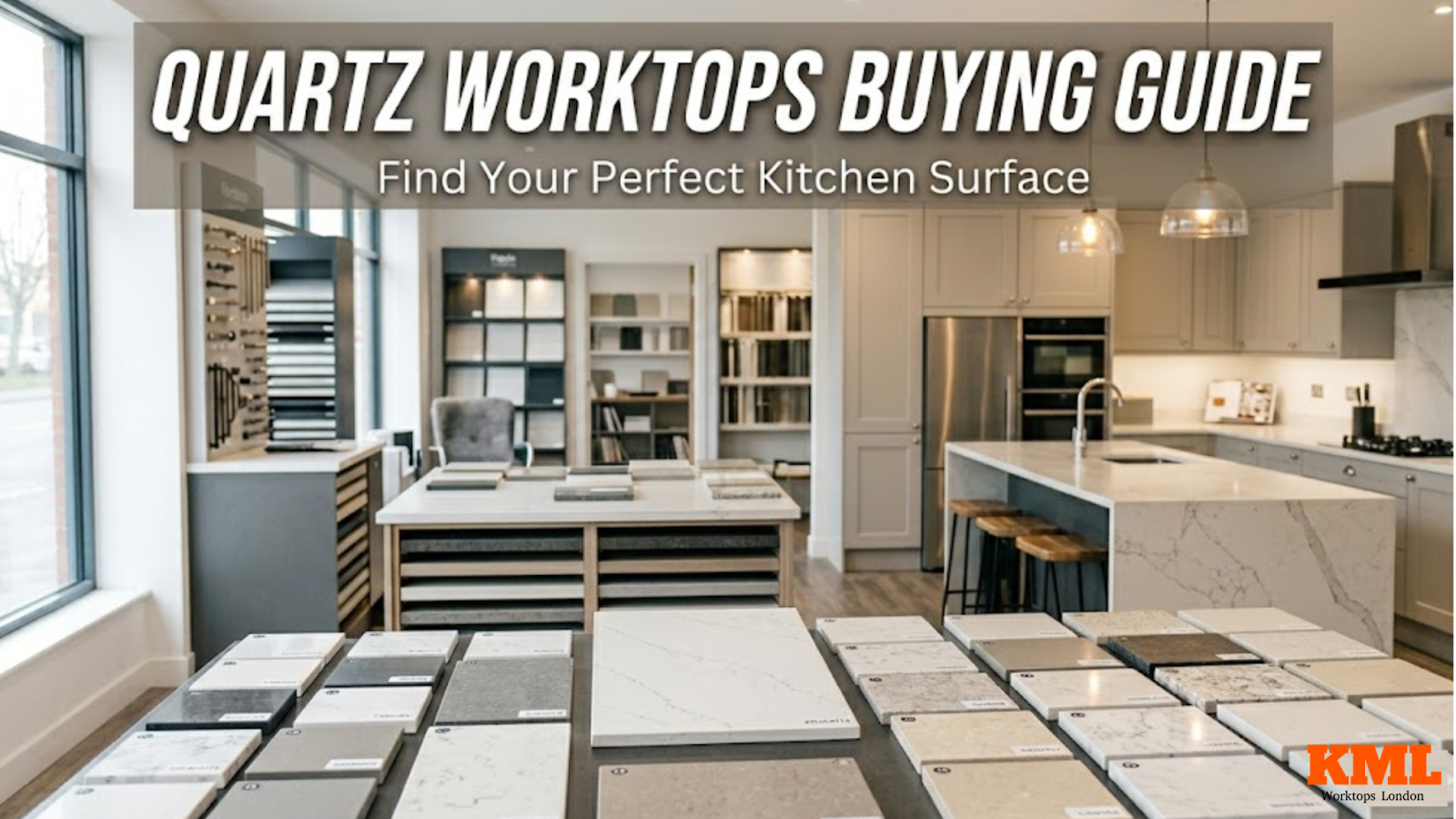
Quartz worktops are a popular choice for kitchens because they offer a durable, low-maintenance surface across a wide range of colours and finishes. But choosing the right one takes more than picking a colour you like from a sample card. This guide covers the key decisions to make before you buy, including thickness, finish, budget, installation costs, and questions worth asking every supplier.
Why Quartz Works Well?
Quartz is an engineered stone, usually made of approximately 90% ground quartz, which has been mixed with resin and pigment. The process used to manufacture quartz results in a product that has a consistent and very hard surface with fewer natural imperfections than granite or marble. As a result of this consistency, quartz worktops offer a dependable way of getting the desired effect that will work well in your kitchen.
It is also valued for its range of designs, from plain white and black surfaces to marble effects, flecked finishes, and bolder veining. Because it is made rather than quarried, you can usually achieve a more uniform colour and pattern across multiple slabs, which matters when you have a large kitchen or an island to match.
Day to day, quartz is easy to live with. It does not need sealing, does not absorb spills easily, and wipes clean without specialist products. That practical side is a big part of why it suits busy kitchens well.
What to Check Before Buying Quartz Worktop?
Before you commit to a slab or a supplier, work through these five areas. Each one affects both the result and the final cost.
Thickness
20 mm is the standard for most kitchens and gives a clean, modern look. 30 mm feels chunkier and suits islands or statement surfaces, but adds cost. Confirm which thickness your cabinets can support before choosing.
Finish
Polished gives a high-gloss reflective look. Honed and matte finishes are softer and less likely to show fingerprints. Leathered and suede finishes add texture and depth, especially on darker colours. Each finish changes how the colour reads in your kitchen.
Colour & pattern
Plain and subtle designs are easier to match with cabinets and flooring, and tend to age better. Dramatic marble-look slabs with heavy veining can be striking, but they are harder to match if you redecorate and often cost more per square metre.
Installation complexity
Cut-outs for sinks and hobs, unusual corners, curved runs, and long spans all add time and cost. Edge profiles also vary in price, a simple square edge costs less than an ogee or waterfall profile. Ask for a breakdown before agreeing to anything.
Total budget
Slab prices are only part of the picture. Always compare total installed costs, including fabrication, delivery, templating, fitting, and VAT. The cheapest slab price rarely reflects the cheapest finished job.
Related Products




Matching Quartz to Your Kitchen Style
The slab you choose should work with what is already in the room, not fight against it.
For modern kitchens with handleless units and clean lines, a neutral quartz in white, light grey, or a plain stone tone usually works best. It lets the architecture of the space do the talking without adding visual noise.
Traditional and rustic kitchens tend to suit warmer tones, creams, soft beiges, and quartz with gentle organic patterning. A polished finish can feel too clinical in these settings; a honed or matte finish usually sits more naturally.
If your cabinets, flooring, or splashback are already bold or heavily patterned, a quieter quartz surface keeps the room balanced. If everything else is minimal, a stronger veining pattern can become a genuine focal point.
| A PRACTICAL EXAMPLE: For a classic London kitchen with light shaker cabinets, a white quartz with subtle grey veining is usually a safer long-term choice than a high-contrast slab. It stays flexible if you repaint the walls or change the flooring later. |
Thickness & Edge Profiles Of Quartz
Two often-overlooked decisions when buying a quartz worktop are the slab thickness and the edge profile. Both affect the final look, the cost, and the installation requirements.
Slab Thickness Options
| Thickness | Type | Weight | Best For | Relative Cost |
| 12mm | Slim/Compact | Light | Vertical cladding, bespoke design features | £ |
| 20mm | Standard | Medium | Most UK kitchen worktops, best value choice | ££ |
| 30mm | Premium/Chunky | Heavy | Kitchen islands, statement surfaces | £££ |
| 40mm | Statement/Bespoke | Very Heavy | Ultra-premium, often laminated 20mm slabs | ££££ |
Common Edge Profiles
The edge profile is the finishing detail on the visible edges of your worktop. Different profiles suit different kitchen styles, and more complex profiles typically add to the overall cost.
| Profile Name | Description | Best Kitchen Style |
| Eased / Square | Clean, flat edge with very slightly softened corners. Crisp and contemporary. | Modern, minimalist, handleless kitchens |
| Bevelled | A 45-degree angled cut along the top edge, subtle but elegant. | Contemporary and transitional styles |
| Bullnose | Fully rounded, smooth edge, soft and safe to the touch. | Family kitchens, traditional designs |
| Pencil Round | A small, subtle radius, popular as an understated standard edge. | Versatile, suits most kitchen styles |
| Ogee | Ornate S-shaped curve, the most decorative profile. | Grand, classic, heritage kitchen styles |
| Waterfall | Worktop extends down the cabinet side, dramatic and seamless. | Contemporary statement kitchens & islands |
Exploring Quartz Worktop Colours
One of the greatest strengths of engineered quartz is the freedom it gives designers and homeowners. Because colour is introduced during manufacturing rather than determined by geology, the range of quartz worktop colours is virtually limitless. Here are the most popular families and how to use them.
White Quartz: The perennial best-seller. A white quartz worktop reflects light, makes spaces feel larger, and pairs with virtually any cabinet colour. Pure white to warm ivory options available.
Grey Quartz: A sophisticated neutral that works in both contemporary and classic schemes. Cool mid-tones are particularly popular in modern Shaker kitchens.
Black Quartz: Bold and dramatic. Black quartz countertops create a stunning contrast against white or light grey cabinetry and conceal minor marks well in daily use.
Cream & Beige: Warm neutral tones that complement wood and earthy palettes. Ideal for farmhouse, country, and rustic kitchen styles where a softer look is desired.
Marble Effect: Captures the dramatic veining of Carrara or Calacatta marble without the porosity. White quartz worktop with grey veining is one of the most sought-after looks in UK kitchens.
Sparkle & Mirror Chip: Embedded glass or mirror chips create a glittering, light-catching effect. Available in white, grey, and black bases, perfect for adding a touch of glamour.
| CHOOSING YOUR COLOUR — DESIGNER ADVICE: Always request physical samples and view them in your own kitchen under both natural and artificial lighting. Colours look very different on a small card versus a full 3-metre worktop. Consider your cabinet colour, floor tone, and splashback when making your final choice. If you’re planning to sell, neutral colours like white and light grey tend to have the broadest appeal. |
Price Planning
Budget quartz options start at under £200 per square metre in some ranges, but the installed cost is almost always higher once fabrication and fitting are included. A realistic budget should account for the slab, labour, cut-outs, edge finishing, and delivery.
| Entry range | Mid range | Premium range |
| Under £300/m²Solid colours, limited profiles. Good everyday performance. Less brand recognition. | £300–£600/m²Wider colour range, marble effects, more edge options. The best value for most buyers. | £600+/m²Premium brands, bespoke finishes, longer warranties. Higher consistency across large slabs. |
What Affects the Total Price?
Beyond the material cost per square metre, your final quote will be influenced by several additional factors:
- Slab thickness, 30mm and 40mm slabs cost significantly more than standard 20mm.
- Edge profile, complex profiles like ogee add fabrication labour costs.
- Cut-outs, each sink, hob, or tap cut-out adds to the fabrication cost (typically £60–£150 per cut-out).
- Upstands and splashbacks, matching quartz upstands create a polished look but add to the total.
- Installation, professional templating and fitting typically adds £200–£500+ depending on kitchen size and complexity.
- Kitchen size, larger kitchens require more material. Larger slabs can also reduce visible seams.
Read Next: Quartz Worktop Prices in the UK
| SMART SAVINGS TIP: Always get at least three quotes that include templating, fabrication, cut-outs, and installation. A lower material price can quickly be offset by higher fitting charges. Look for suppliers offering free templating as part of a complete package. Budget quartz worktops don’t mean low quality, many affordable quartz countertops perform identically to premium-branded equivalents. |
Quartz Worktop Buying Checklist
Work through this before committing to a supplier or slab.
| Before you order | When comparing suppliers |
| Measure accurately, include corners, cut-outs, and overhangs | Ask for a total installed quote, not just material price |
| Decide on thickness: 20 mm or 30 mm | Confirm templating, fabrication, delivery, and VAT are included |
| Choose a finish: polished, matte, honed, or leathered | Check how sink, hob, and tap cut-outs are priced |
| Match colour and pattern to cabinets, floor, and splashback | Confirm the installer templates in person before fabrication |
| View samples in your own kitchen, not just in a showroom | Ask about lead times if you have a renovation deadline |
| Consider how the surface will look at full slab scale | Check the warranty on both the product and the installation |
Questions to Ask Worktop Suppliers
A reliable supplier will answer all of these clearly and in writing.
| Ask this | Why it matters |
| What is included in the total price? | Avoids surprises when the invoice arrives. |
| How many joins will my layout need? | More joins mean more visible seams and more risk of mismatches. |
| Do you template in person before fabricating? | Remote measurement increases the chance of a poor fit. |
| What thickness and edge profile do you recommend? | Tests whether they understand your kitchen, not just the sale. |
| What happens if the slab is damaged during fitting? | Establishes accountability before anything goes wrong. |
| Can I see recent local projects or speak to past customers? | The best evidence of reliable workmanship is completed jobs. |
Frequently Asked Questions
Q1 Is a quartz worktop better than granite?
For most UK households, yes. Quartz requires no sealing, offers more colour consistency, and is easier to maintain day-to-day. Granite has a unique natural beauty that some prefer, but quartz is the more practical choice for busy kitchens.
Q2 How long do quartz work tops last?
With normal use and proper care, a quality quartz worktop should last 25 years or more. Most reputable manufacturers offer warranties of 10–25 years as standard.
Q3 Can I put hot pans on a quartz worktop?
No, this is a common misconception. Quartz is heat-resistant but not heat-proof. The resin binders can discolour or crack under sudden thermal shock. Always use a trivet or heat mat.
Q4 Which white quartz worktop is most popular in the UK?
Calacatta-effect whites with subtle grey veining remain the most popular choice, followed by pure bright whites. Silestone’s “Eternal Calacatta Gold” and Caesarstone’s “5031 Calacatta Nuvo” are perennial bestsellers.
Q5 How can I find affordable quartz countertops in the UK?
Compare at least three quotes from local fabricators, consider using remnant slabs for smaller kitchens, and look at own-brand ranges from established suppliers. The mid-range (£250–£350/m²) offers the best balance of quality and value for most buyers.
Q6 Do quartz worktops add value to my home?
Yes, quality kitchen worktops are consistently cited by estate agents as one of the improvements that adds tangible value and saleability to a UK property. Quartz is perceived as a premium, desirable material by buyers.