Key Takeaways
- Quartz worktops combine 90% to 95% crushed natural quartz with polymer resin and pigment to deliver high hardness and stain resistance.
- The polymer resin acts as a binder that fills gaps between quartz particles, creating a non-porous surface that requires no sealing.
- Pigments and decorative additives like glass or mirror flecks allow manufacturers to achieve a consistent palette and varied patterns.
- While resistant to stains and everyday wear, quartz worktops require trivets for hot pans because the resin binder can scorch under direct heat.
- Maintenance is simple, requiring only warm water, mild soap, and a soft cloth, while avoiding harsh chemicals and abrasive pads.
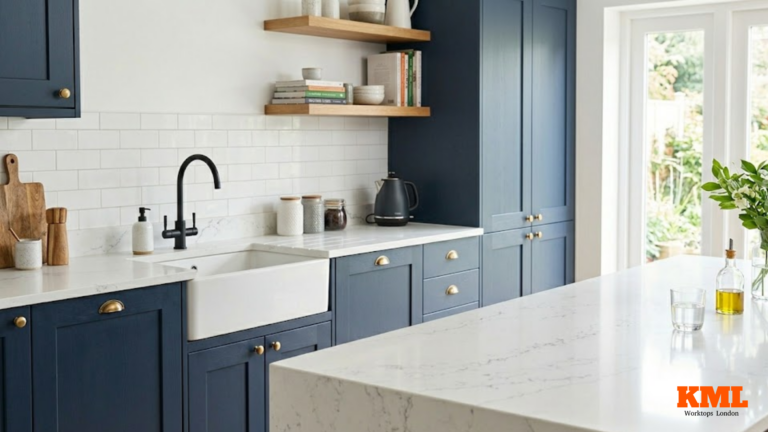
Quartz worktops combine crushed natural quartz with polymer resin and pigment. The mix usually runs 90% to 95% quartz. That ratio gives quartz its trademark hardness, its resistance to stains, and a far more uniform look than a slab of granite or marble cut straight from the ground.
It’s a fair question to ask, because the name is a bit misleading. “Quartz worktops” sounds like it should mean solid quartz, but no manufacturer makes a countertop from quartz alone. Here’s a proper breakdown: what goes into one, how factories build it, and how the numbers compare across brands.
How Much Natural Quartz Is Actually in a Quartz Worktop?
Most engineered quartz worktops carry 90% to 95% crushed natural quartz. Resin, pigment and sometimes recycled glass or mirror fleck make up the rest. Silestone runs around 93% quartz, and CRL builds its range to the same ratio. The exact split changes by manufacturer and by colour, so two similar-looking slabs can hide different formulas underneath.
Manufacturers pick natural quartz because it’s one of the hardest minerals you’ll find in a kitchen. Silicon and oxygen lock into a tightly packed crystal structure, and that structure gives quartz worktops their resistance to scratching, chipping and everyday knocks. Factories source the raw mineral from natural deposits, crush it into different particle sizes, from fine powder to larger fragments, then clean and grade it before it reaches a mould.
What Does the Resin Actually Do?
Crushed quartz alone is just loose grit. It needs a binder to become a slab, and that’s the resin’s job. During manufacturing, workers mix resin through the quartz aggregate, then press and cure the whole batch. That step turns loose mineral particles into one solid, load-bearing surface.
The resin does more than bind the material together. It also explains why quartz worktops skip the sealing that granite and marble often need. Resin fills the gaps between quartz particles almost completely, so the finished surface stays non-porous and liquids sit on top instead of soaking in. That’s part of why quartz shrugs off red wine, coffee and turmeric better than most natural stone.
Heat is the trade-off. Resin can’t handle heat as well as quartz itself, so a pan straight off the hob can scorch or discolour the surface where it touches. Keep a trivet or heat pad under hot cookware. It’s the one habit that protects a quartz worktop long term.
What Gives Quartz Worktops Their Colour and Sparkle?
Pure natural quartz usually looks colourless or milky white. Pigment added during manufacturing creates almost every colour you see in a showroom. This process also lets quartz reach a consistent, repeatable palette, from bright whites and warm creams through to charcoal, black and deep browns, in a way natural stone can’t match slab to slab.
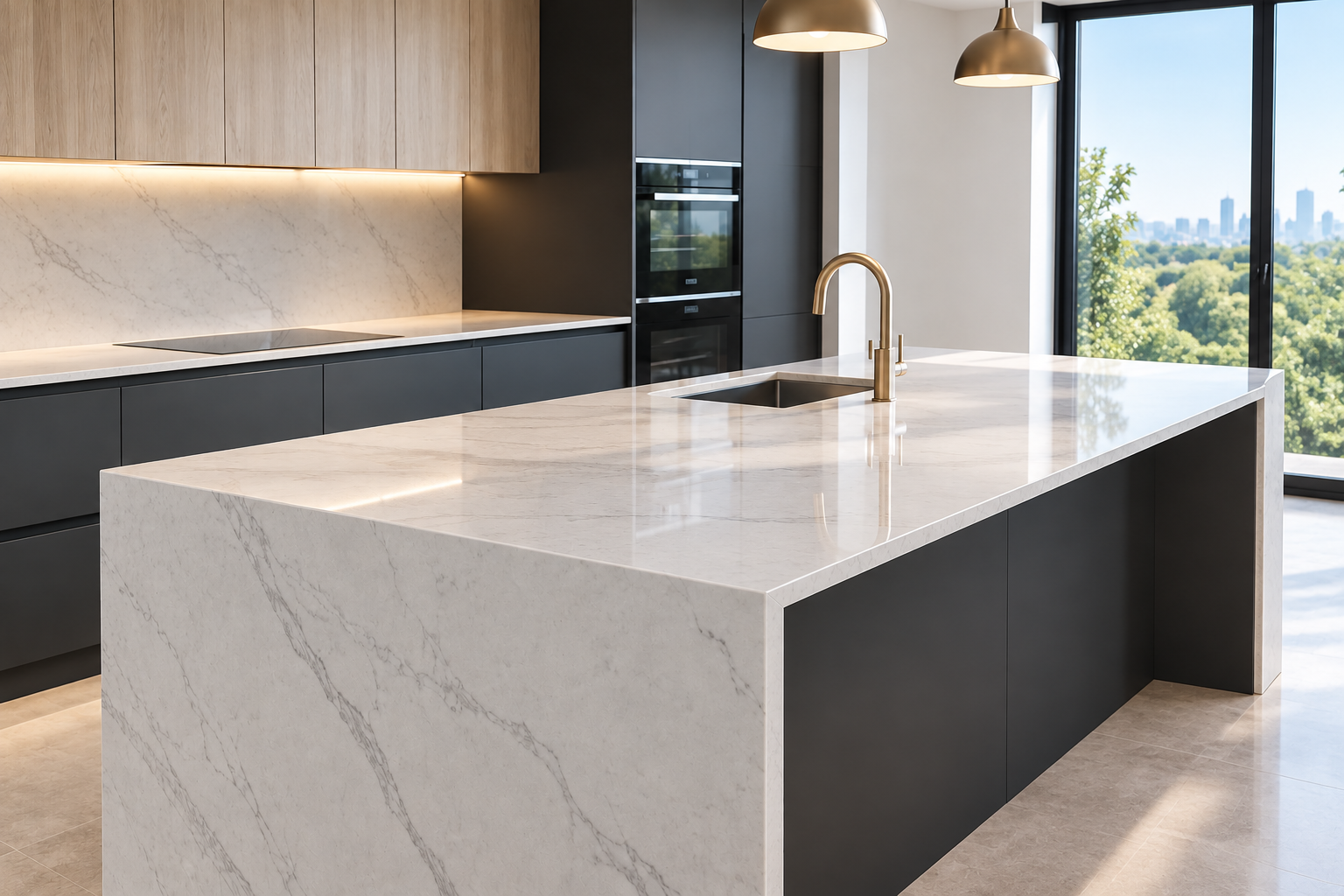
Manufacturers add sparkle and veining separately. They work mica flakes, glass chips, mirror fragments or fine stone particles into the mix alongside the pigment, which creates shimmer, movement or a marble-like vein running through the surface. Some ranges copy Carrara marble or granite directly, so you get that look with quartz’s easier upkeep.
How Are Quartz Worktops Manufactured?
The process explains a lot about why quartz behaves the way it does once it’s installed:
● Quarrying and crushing: workers extract natural quartz and break it into a mix of particle sizes.
● Mixing: the quartz aggregate is combined with polymer resin, pigment and any decorative additions according to the manufacturer’s formula.
● Compacting: the mixture goes into a mould under heavy pressure, often with vibration and vacuum technology to force out air pockets.
● Curing: a kiln or curing chamber heats the slab so the resin sets and binds everything permanently.
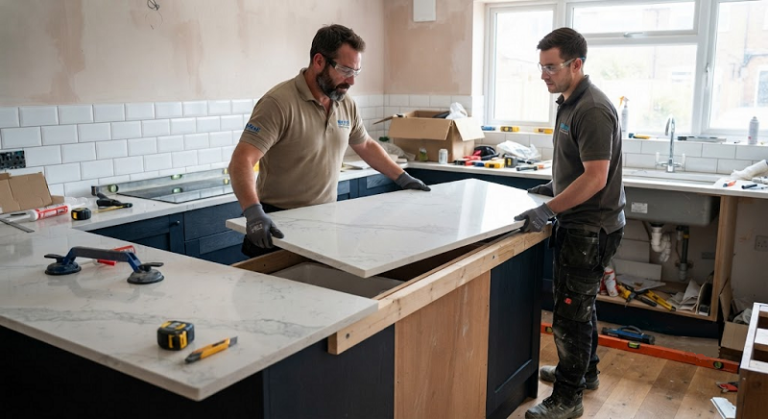
● Finishing: once cured, workers calibrate and polish the slab (or hone it for a matte finish), then inspect it before cutting it for individual kitchens and bathrooms.
That vacuum and pressure stage matters more than it sounds. It removes the tiny air pockets that would otherwise leave the surface porous, and that’s the main reason engineered quartz beats most natural stone on stain resistance.
Are Quartz Worktops Fully Natural?
No, and any brand that claims otherwise is stretching the truth. Quartz worktops use real quartz mineral, but combine it with man-made resin and pigment rather than cutting it whole from a quarry. That’s not a downside, it’s the whole point. The engineering makes the slabs uniform, non-porous and available in colours natural quartz never reaches on its own.
How Do You Clean and Care for a Quartz Worktop?
Quartz need for very little day to day. Warm water, a mild washing-up liquid and a soft cloth handle most spills, including coffee, wine and food colouring, without leaving a mark. You won’t need sealants, waxes or specialist stone cleaners.
Avoid a few things, though: harsh chemical cleaners, bleach-based products, and anything abrasive like scouring pads, since these dull the surface finish over time. And as covered above, keep a trivet under hot pans, even though quartz handles heat reasonably well.
Where Are Quartz Worktops Used?
Kitchens are the obvious application, for both worktops and splashbacks. But the same non-porous, low-maintenance qualities make quartz a popular choice for bathroom vanities, utility rooms, home bars and even commercial counters in cafes and offices, where durability under constant use matters just as much as looks.
Does Composition Affect the Price?
Yes, indirectly. The ratio of quartz to resin, the complexity of the pigment or veining pattern, and the finish (polished, honed or textured) all feed into the cost of a slab. Rarer colours and more intricate patterns usually need more careful mixing and tighter quality control, so they sit at the higher end of the price range. Simpler, solid colourways generally cost less.
Conclusion
So, what are quartz worktops made of? In short: mostly crushed natural quartz (around 90% to 95%), held together with polymer resin and coloured with pigment, sometimes with decorative extras like mica or glass mixed in. That combination is exactly why quartz worktops end up harder, more stain-resistant and more consistently patterned than the natural stone they’re often compared against, while still needing the odd bit of common-sense care, like keeping hot pans off the surface directly.
Frequently Asked Questions
Q1: Are quartz worktops 100% quartz?
No. They typically carry 90% to 95% crushed natural quartz combined with polymer resin, pigment and sometimes decorative materials like glass or mirror fleck.
Q2: Is quartz better than granite?
It depends on what you’re after. Quartz is non-porous, needs no sealing, and gives a consistent pattern. Granite is fully natural stone with one-of-a-kind veining, but it needs periodic resealing.
Q3: Can you put a hot pan directly on a quartz worktop?
It’s not recommended. Quartz is heat-resistant, not heatproof, and the resin binder can scorch or discolour under direct, prolonged heat. Use a trivet.
Q4: Do quartz worktops need sealing?
No, the resin content makes the surface non-porous, so routine sealing isn’t required, unlike most natural stone.
Q5: How long do quartz worktops last?
With normal care, quartz worktops commonly last 20 years or more, which is part of why the higher upfront cost tends to pay off over time.