Key Takeaways
- Quartz worktop installation in the UK typically costs between £300–£500 per m², or roughly £2,000–£4,000 for an average kitchen.
- Quartz is an engineered, non-porous material made of crushed natural quartz bound with resins, meaning it does not require annual sealing.
- The installation process involves three main stages: a measuring and templating visit, off-site cutting and polishing in a workshop, and a final fitting day.
- Fitting quartz is not a recommended DIY project due to the heavy weight of the slabs, the risk of cracking, and the health hazards associated with respirable crystalline silica dust.
- Maintenance is simple, requiring only a soft cloth, warm water, and mild washing-up liquid, avoiding harsh chemicals, abrasive scourers, and direct heat.
Quartz worktop installation typically takes one working day once your kitchen units are in place, and involves three stages: a measuring/templating visit, off-site cutting and polishing in a workshop, and a fitting day where the finished slabs are bonded to your cabinets and jointed together. Most UK homeowners pay in the region of £300–£500 per m², or roughly £2,000–£4,000 for an average kitchen, supplied and fitted.
Quartz has become one of the most popular worktop choices in UK kitchens and bathrooms because it looks like natural stone but behaves far better day to day, it resists stains, scratches and moisture without the sealing that granite or marble need. This guide walks through how installation actually works, what it costs, what can go wrong, and how to look after the finished surface.
Why UK Homeowners Choose Quartz
Quartz worktops are engineered, not quarried: crushed natural quartz is bound with resins and pigments under pressure, which is why the colour and pattern stay consistent across a whole slab in a way natural stone can’t match. The result is a dense, non-porous surface that doesn’t need annual sealing, copes well with everyday kitchen spills, and comes in a wide range of finishes to suit both period and modern kitchens.
According to Howdens, one of the UK’s largest kitchen suppliers, quartz worktops are valued for their durability, easy-clean surface and the range of modular colours available, which is why they’re now a default option in many new-kitchen quotes rather than a premium upgrade.
What Happens Before Installation Day
Survey and template
Before anything is cut, a fabricator visits to measure your kitchen and take a template, traditionally a fitted MDF or plastic template, though many UK fitters now use a digital laser template instead. This step matters because quartz is cut to precise dimensions in the workshop and can’t easily be trimmed on site, so the survey has to account for cabinet alignment, floor levels, appliance positions and sink or hob cut-outs before the slab is ever cut.
It’s worth checking that your base units are fully fitted, level and secured before the template visit, cabinets that shift after templating are one of the most common causes of a poor-fitting worktop.
Choosing a thickness
Quartz worktops are commonly supplied in 12mm, 20mm and 30mm thicknesses. 20mm and 30mm are the most popular quartz for kitchens because they give a sturdier look and edge; 12mm is lighter and cheaper but usually needs a plywood substrate underneath for support. Thicker slabs also cost more and need stronger cabinet carcasses to bear the weight, so it’s worth confirming your unit strength with the fabricator at quoting stage.
Materials And Tools Used In A Professional Installation
A fabricator’s kit for cutting and fitting quartz typically includes a plunge saw or diamond bridge saw, a router for edge profiles and cut-outs, a sander for finishing joints, clamps, guide rails, a jigsaw for tighter cuts, and eye and respiratory protection. Sink and hob cut-outs are almost always machined off-site in a workshop rather than on site in your kitchen, this gives a cleaner cut and, importantly, keeps dust-generating cutting away from your home. More on why that matters below.
Step-By-Step: How Quartz Worktop Installation Works
1. Delivery
Finished slabs are delivered to the property. Quartz is heavy, a large single slab can weigh well over 100kg, so it’s carried on edge, never flat, and access (stairs, narrow hallways, tight doorways) should be flagged to the supplier in advance.
2. Dry fit
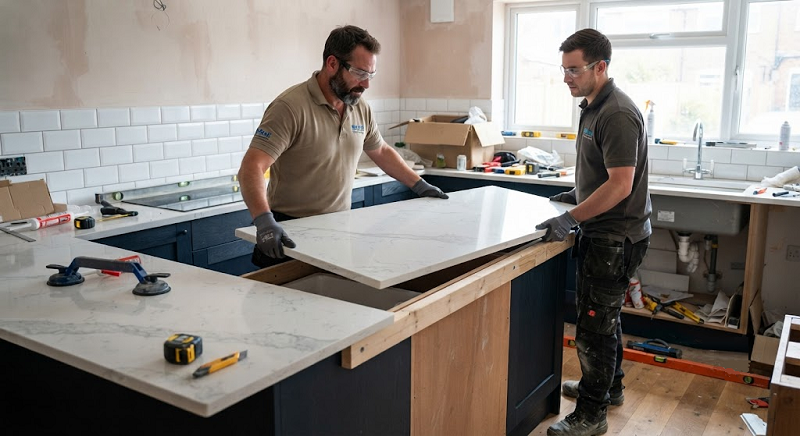
Installers place the cut pieces onto the cabinets without fixing them, to check alignment, joint positions and that appliance cut-outs line up correctly. This is the point to raise any concerns before anything is permanently bonded.
3. Bonding to the cabinets
Once the dry fit is approved, the worktop is fixed to the cabinet carcasses using a construction adhesive, and any joints between separate slabs are filled with a colour-matched resin so the seam is as unobtrusive as possible.
4. Fitting sinks, taps and splashbacks
Sinks, hobs, taps and any matching splashbacks are fitted last, and the surface is cleaned down and handed over.
5. Letting it cure
Most fabricators recommend avoiding heavy weight or pressure on new joints for around 48 hours while the bonding resin fully cures, even though the surface is safe to wipe down and use lightly straight away.
How Much Does Quartz Worktop Installation Cost In UK?
Expect to pay roughly £300–£500 per m² for quartz supplied and fitted, which usually works out to about £2,000–£4,000 for a typical kitchen. The exact figure depends on the colour and brand you choose, slab thickness, the number of joints and cut-outs needed, and your location. Getting quotes from two or three local fabricators is the most reliable way to benchmark a fair price, since national averages can be skewed by London-based pricing.
Can I Install A Quartz Worktop Yourself?
Fitting quartz is not a realistic DIY job, and it’s worth understanding why rather than just taking that on trust. Quartz is heavy, brittle under the wrong kind of stress, and needs specialist diamond-tipped tools to cut cleanly, a slab can crack if it’s lifted or cut incorrectly, and there’s no easy way to trim a mis-cut piece.
There’s also a genuine safety reason to leave cutting to professionals: the Health and Safety Executive (HSE) published updated 2025 guidance for installers of stone worktops, reminding fabricators to eliminate on-site cutting wherever possible and to control exposure to respirable crystalline silica (RCS), the fine dust released when engineered stone is cut, ground or polished, which has been linked to serious lung conditions including silicosis in stoneworkers. This is exactly why reputable UK fabricators do sink and hob cut-outs in a controlled workshop rather than in your kitchen: it isn’t just about a cleaner finish, it materially reduces dust exposure for everyone in the house. It’s a good question to ask any fitter you’re quoting, where the cutting happens, and what dust controls they use.
Tips To Avoid Damage During And After Installation
- Always lift worktops from the side, never flat, carrying a slab flat puts it under stress it isn’t designed for.
- Keep the area around the worktop clear during fitting; don’t stack tools, boxes or offcuts against a newly fitted edge.
- Handle quartz worktops with care when removing protective covering, don’t drag or scrape covers off.
- Keep hob and sink cut-outs at least 100mm from any edge or joint, as advised by most fabricators, to avoid weak points.
- Avoid direct heat contact, use a trivet or pan stand, even though quartz is more heat-resistant than laminate.
- Check that cabinets are level and fully secured before fitting begins.
Cleaning And Maintaining A Quartz Worktop
Quartz is genuinely low-maintenance. Wipe it down with a soft cloth, warm water and a mild washing-up liquid, then dry it to bring back the shine. Because the surface is non-porous, everyday spills, tea, coffee, wine, sauces, don’t soak in or leave a permanent stain if you clean them up in reasonable time. Avoid abrasive scourers, bleach-based cleaners and harsh solvents, which can dull the resin finish over years of use, and use a chopping board rather than cutting directly on the surface.
Conclusion
Quartz worktop installation is a precision job best left to a trained fabricator, but understanding the process, templating, off-site cutting, fitting and curing, makes it much easier to plan around, budget for, and ask the right questions during quoting. Get a proper survey, confirm your cabinets are level and ready, ask where cutting will happen, and you’ll end up with a worktop that needs very little upkeep for years afterwards.
Frequently Asked Questions
Q1 How long does it take to install a quartz worktop?
Fitting day itself usually takes a few hours to a full day, once the slabs have been templated and fabricated. The full process from initial survey to finished installation, including workshop fabrication time, typically takes one to three weeks, so it’s worth booking your fabricator well before your kitchen fit-out date.
Q2 How much does quartz worktop installation cost in the UK?
Most UK homeowners pay around £300–£500 per m² for quartz supplied and fitted, which is typically £2,000–£4,000 for an average kitchen. Cost depends on the brand and colour, thickness, number of joints, and any sink or hob cut-outs required.
Q3 Do quartz worktops need sealing?
No. Quartz is non-porous by design, so unlike granite or marble it doesn’t need sealing at installation or resealing over time. That’s one of the main reasons homeowners choose it over natural stone.
Q4 Can quartz worktops be damaged by heat?
Yes, direct contact with hot pans or dishes can damage the resin binder in quartz over time, even though it’s more heat-tolerant than laminate. Always use a trivet or pan stand rather than placing hot cookware straight onto the surface.
Q5 Can you fit a quartz worktop yourself?
It isn’t recommended. Quartz needs specialist diamond-tipped cutting equipment to avoid cracking, the slabs are heavy and awkward to handle safely without training, and cutting engineered stone releases silica dust that the HSE advises should be controlled by trained installers using the right equipment. It’s a job for a professional fabricator.
Q6 What’s the best way to clean a quartz worktop?
A soft cloth, warm water and a mild washing-up liquid is all you need for everyday cleaning. Dry the surface afterwards to keep the finish looking sharp, and avoid bleach, abrasive scourers or strong solvents, which can dull the surface over time.
Q7 Does quartz worktop crack, chip or stain?
Quartz is one of the more durable worktop materials available, but it isn’t indestructible, a sharp, heavy impact on an edge or corner can chip it, and poor-quality installation (unsupported overhangs, weak joints) is the most common cause of cracking. Staining is rare because the surface is non-porous, provided spills are cleaned up within a reasonable time.
Q8 How much overhang can a quartz worktop have without extra support?
As a general rule, an unsupported quartz overhang beyond about 300–400mm (for standard 20–30mm thickness) usually needs additional support, such as steel brackets or a corbel, particularly for breakfast bars and islands. Your fabricator will confirm exact limits based on the thickness and span you’re planning, since this varies by product.