Key Takeaways
- Cutting a granite worktop yourself is possible with a diamond blade, plenty of water, patience, and proper safety equipment including an FFP3 dust mask.
- Essential preparation includes making a template, marking the granite twice, applying painter's tape along the cut line to prevent chipping, and securely supporting the slab.
- The cutting process should be done in multiple shallow passes while keeping the blade continuously wet to avoid overheating the blade and cracking the stone.
- Sink and hob cut-outs require starting from the inside with corner holes drilled using a diamond core bit, followed by careful cutting and polishing of the edges.
- Professional fabrication services in the UK typically cost between £50 and £100 just for a cut, while full installation ranges from £200 to £600 per square metre.
Granite doesn’t care that you’re in a hurry. Cut it right, and you’ll get a clean, sharp edge that looks like it came from a fabricator’s workshop. Rush it, and you’ll either chip the leading edge or crack the slab clean through, which is an expensive way to learn a lesson. If you’re wondering how to cut a granite worktop yourself, the short answer is: with a diamond blade, plenty of water, and a lot more patience than you think you’ll need. Here’s exactly how it’s done, what it costs if you’d rather leave it to a professional, and how to tell which option actually suits your kitchen.
Can you cut a granite worktop yourself?
Yes, but it’s a job where ‘can’ and ‘should’ don’t always agree with each other. Granite worktop is a dense natural stone, so a slab the size of a kitchen worktop can weigh well over 100kg, and it will crack along an existing fault line if you don’t support it properly while you cut it. There’s also a health side to this that most guides skip over: cutting granite dry, or without the right mask, throws up fine silica dust, and the UK Health and Safety Executive treats respirable crystalline silica as a serious long-term lung hazard for anyone working with stone regularly. For a one-off cut in a well-ventilated garage with a wet blade and a proper FFP3 respirator, the risk is manageable. If you’re not confident you can keep the cut wet and controlled throughout, that’s your answer.
What tools do you need to cut a granite worktop?
You don’t need a professional workshop, but you do need the right kit. Skipping any of these is usually where things go wrong.
- A diamond blade, continuous rim rather than segmented, rated for wet cutting
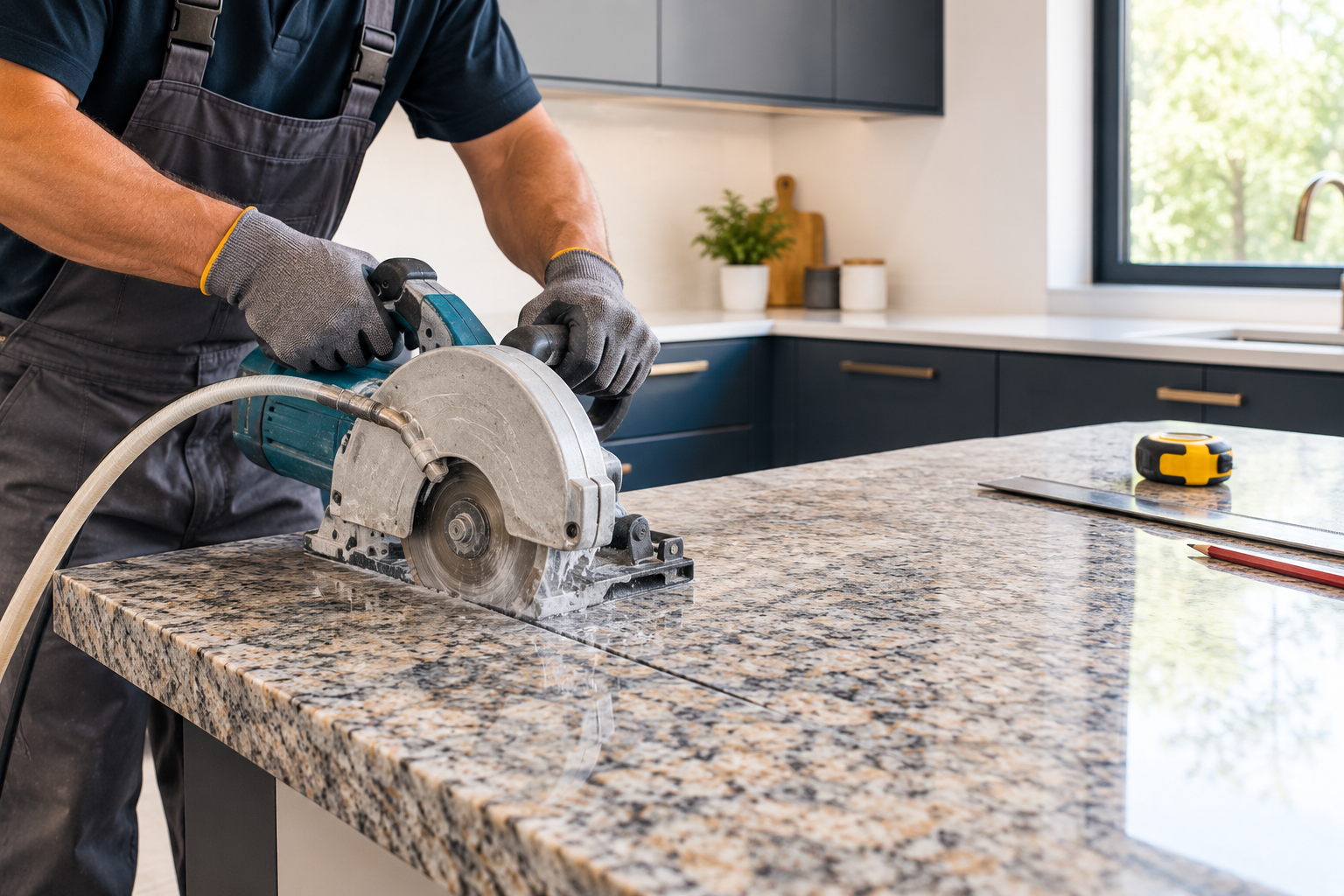
- A circular saw or a 9-inch angle grinder. A small 115mm grinder is not strong enough for granite, and trade forums specifically warn against it
- A hardboard or template of the exact cut you need, plus a straightedge for anything simple
- Masking or painter’s tape to run along the cut line and stop the edge chipping
- Clamps and a solid workbench or a pair of sawhorses
- A tape measure, pencil and a spirit level
- A hose, spray bottle or helper to keep the blade wet while you cut
- Proper safety gear: goggles, ear defenders, gloves and an FFP3 dust mask, not a basic paper one
- Diamond polishing pads to finish the edge once it’s cut
How to cut a granite worktop, step by step
- Template it first. Cut a hardboard or cardboard template to the exact shape you need and test it against the cabinet run before you go anywhere near the slab.
- Mark the granite twice. Transfer the template onto the slab with a pencil, then check the measurements again. There’s no undoing a cut that’s a centimetre out.
- Tape the line. Run painter’s tape along the cut line and re-mark it on top of the tape. This alone prevents most of the chipping people complain about.
- Support the slab properly on a bench or sawhorses, and clamp it so it can’t shift. Make sure both sides of the cut line are supported, or the offcut can snap away and tear the edge as it falls.
- Score a shallow guide pass, only a few millimetres deep, along the full length of the line before you try to cut through.
- Cut in multiple passes, keeping the blade wet throughout. Let the diamond blade do the work rather than pushing it; forcing the pace is what overheats the blade and cracks the stone.
- Back-cut the last couple of inches. Approach the finishing end of the line from the opposite direction for the final section, so the granite doesn’t snap off unsupported at the very end of the cut.
- Polish the cut edge with diamond pads, working from a coarse grit through to a fine one, until it matches the factory finish on the rest of the worktop.
How do you cut a hole in a granite worktop for a sink or hob?
The principle is the same, but you start from the inside instead of an edge. Mark the cut-out using the manufacturer’s template for your sink or hob, then drill a starter hole at each corner with a diamond core bit, angled slightly inward so the corners aren’t perfectly square (square internal corners are where granite is most likely to crack under heat or pressure later on). From there, connect the corners using a diamond blade angle grinder rather than a circular saw, since you’ll need to follow a tighter, sometimes curved, line. Take the waste piece out in sections rather than trying to drop it out whole, and finish by polishing the underside edge of the cut-out so it’s smooth where the sink lip or hob frame sits against it.
How do you stop granite from chipping when you cut it?
Chipping almost always comes down to one of three things: no tape on the line, a blunt or wrong-type blade, or forcing the tool instead of letting it cut at its own pace. Keep the cut wet, keep the blade sharp, support both sides of the line so nothing drops unsupported, and back-cut the finishing edge as described above. If you do all four, chipping is rare even on a first attempt.
How much does it cost to cut a granite worktop in the UK?
If you already own a suitable slab and just need a straight cut made, a local stone merchant or fabricator will typically do it for somewhere around £50 to £100, and it takes them minutes with the right equipment. A full job- template, cut, worktop edge profiles and installation of a new granite worktop- generally runs from around £200 to £600 per square metre in the UK, depending on the granite’s colour, rarity and finish. Compare that to the cost of a slab you’ve cracked trying to save on the fitting fee, and paying for the cut is usually the cheaper mistake to avoid making.
Should you cut it yourself or call a professional?
Cutting it yourself makes sense for a straightforward, single straight line, on a slab you’re not precious about, when you already own or can hire a decent wet saw. Calling in a professional makes more sense for sink and hob cut-outs, curved edges, anything on an expensive or rare granite, or if you’ve never handled a diamond blade before. Most fabricators will also cut a slab you supply for a flat fee, so you don’t have to choose between full DIY and a full professional install; you can simply hand over the heaviest, riskiest part of the job and finish the rest yourself.
Conclusion
Cutting a granite worktop yourself is a realistic weekend job if you respect what the stone can do to a blade, or a blade can do to you, and you take it slowly. If you’re still choosing a granite in the first place, our Granite Worktop Designs page is a good place to see finishes and edge profiles before you commit, and our Granite Worktops Guide covers everything from sealing to day-to-day care once your worktop is fitted and cut to size.
Frequently Asked Questions
Q1: Can I cut granite with an angle grinder?
Yes, a 9-inch angle grinder fitted with a diamond blade will cut granite. A small 115mm grinder generally won’t have enough power or blade diameter to do it safely.
Q2: Do I need a wet saw to cut granite?
You don’t strictly need a dedicated wet saw, but you do need to keep the blade wet somehow, whether that’s a saw with a built-in water feed or someone spraying the cut with a hose as you go. Cutting dry creates far more dust and wears the blade out faster.
Q3: Is granite dust dangerous?
Yes, Dry-cutting granite releases fine silica dust, which the HSE classes as harmful to breathe in over time. Always cut wet, work in a ventilated space, and wear an FFP3 mask rather than a basic dust mask.
Q4: Can a granite worktop be cut after it’s already installed?
It’s possible for a small adjustment, but it’s much harder to control dust and support the slab safely in situ. For anything beyond a very minor trim, it’s worth calling a fabricator out to do it on-site.