Key Takeaways
- Corian is a solid surface made from a mixture of natural minerals and acrylic resins, offering a smooth, uniform, and repairable finish.
- Quartz worktops consist mostly of natural quartz crystals bonded with resins and pigments, providing exceptional strength and stone-like durability.
- Corian excels in design flexibility, allowing for seamless joints, integrated sinks, and curved shapes, while quartz offers superior scratch and heat resistance.
- Both materials are non-porous and do not require sealing, but Corian's seamless installation makes it particularly hygienic for commercial and health facilities.
- Corian generally has a lower upfront cost, whereas quartz is often perceived as a higher-end feature that can contribute more positively to property resale value.
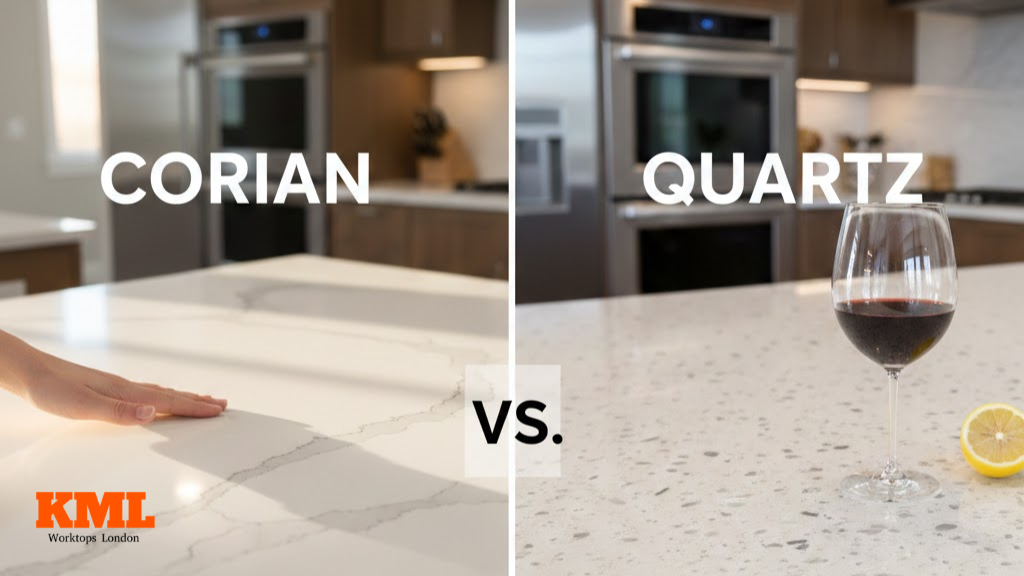
When selecting premium surfaces for modern kitchens, homeowners often face the question of Corian vs Quartz. Both materials are widely recognised as high end solutions and are frequently listed among the best kitchen worktops available today. Nevertheless, although the two seem to have a similar outlook and are engineered, Corian and quartz have a major difference in composition, performance and their optimal uses.
This detailed guide compares Corian vs Quartz worktops across material makeup, durability, maintenance, cost, and best applications so you can make an informed choice.
Corian and Quartz Worktops
What Is Corian® Solid Surface?
A Corian countertop is a solid surface created through a mixture of natural minerals and acrylic resins. Consequently, it provides a non-porous finish which has a smooth surface, and the entire slab is uniform in colour. In discussions around choosing Corian or quartz, Corian countertops are often highlighted for their versatility, seamless appearance, and repairability.
What Is Quartz?
Quartz worktops are designed with stone tops that are made of mostly natural crystals of quartz bonded with resins and pigments. This type of manufacturing process results in a very hard and strong surface. Quartz worktop is typically associated with strength, stone-like aesthetics, and long-term resilience.
Both materials are classified as premium worktop types and are widely used in modern kitchens.
Corian vs Quartz Worktops Comparison Table
| Feature | Corian Worktops | Quartz Worktops |
| Material Type | Solid surface (acrylic-based) | Engineered stone |
| Durability | Medium | High |
| Scratch Resistance | Moderate | Excellent |
| Heat Resistance | Moderate | High |
| Seamless Joints | Yes | No |
| Design Flexibility | Very high | Limited |
| Maintenance | Easy, repairable | Very low |
Key Difference Between Corian and Quartz
The major aspect of Corian and quartz consists in their composition, flexibility, and performance as kitchen worktops. While both are premium worktop types, Corian focuses on seamless design and versatility, whereas quartz prioritises strength and stone-like durability.
Composition and Structure
- The Corian is produced with about two to third portions of natural minerals and one-third of acrylic resin. It is through this structure that Corian acquires its smooth texture, flexibility and smooth look.
- Quartz worktops, on the other hand, are manufactured by using about 90-94% of natural quartz crystals, cemented with resins. The use of a high content of quartz makes the surface very hard, dense and very close to natural stone.
Durability and Daily Performance
- Quartz worktops are among the hardest worktop types available. They are very durable when it comes to scratches, chips and overall wear, thus they can take up a lot of business in the kitchen as they can be used daily.
- Corian, on the other hand, is also durable but a little softer than quartz. While it may scratch more easily, a key advantage in the corian vs quartz comparison is that Corian scratches and minor damage can be sanded and polished away seamlessly, restoring the original finish.
Heat Resistance Comparison
- Quartz worktops are more resistant to heat and can withstand such successive heat in a brief period of time. Nevertheless, even after a long period of working with exposure to extreme heat, the problem can still be harmed, and the usage of trivets is recommended.
- Corian worktops are sensitive to heat. Surface marks may also occur due to direct contact with hot pans, but they may frequently be repaired. Good maintenance would guarantee the longevity of both surfaces.
Seamless Appearance and Aesthetic Appeal
- Corian worktops may be manufactured with almost zero joints or with straight continuity of the surface produced. This is what is especially attractive about Corian with respect to the minimalist and contemporary design.
- Quartz worktops, though aesthetically pleasant, will never have joints that are not visible because of limitations on the sizes of slabs. Such seams are subtle yet unable to be completely covered.
Corian has a wide variety of colours and patterns in terms of colour choice, covering bold and modern colours. Different designs with quartz are also numerous, and many of them are similar to the veining and the texture of the natural stone.
Hygiene and Maintenance
Hygiene is a priority for modern kitchens, especially when evaluating the best kitchen worktops.
Corian and quartz are non-porous materials, which implies that it does not allow water, stains, or bacterial growth. Neither surface needs to be sealed, unlike worktops made of natural stone.
In the Corian countertops vs quartz countertop comparison, Corian has a slight advantage due to its seamless joints, which eliminate crevices where dirt and bacteria could accumulate. This has made Corian generally used in health facilities and commercial places.
Both materials can be cleaned using weak detergents regularly.
Versatility and Design Flexibility
Corian is very versatile compared to quartz. It can be thermoformed into curved shapes, integrated sinks, and bespoke designs that are not possible with harder worktop types.
You can feel the luxurious and heavy feel of quartz, though it is not very flexible. Its crystalline construction is able to provide a smooth, stone-like appearance attractive to any homeowner who wants a traditional or luxurious finish.
Cost Considerations
When evaluating corian countertops and quartz countertops, cost differences are generally marginal and depend on colour, thickness, and installation complexity.
Corian comes at reshape slightly cheaper, especially in customised designs that need to be bent or have smooth joins. Quartz will be slightly more costly, particularly in darker or exotic finishes.
Price and Resale Opportunities
Upfront Cost
Corian countertops are generally more affordable, with prices typically ranging from £19 to £59 per square foot. Quartz countertops usually start at around £29 per square foot and can extend beyond £146 per square foot, depending on the design, finish, and brand. This makes Corian the lower cost option at the initial purchase stage, while quartz requires a higher upfront investment.
Resale Impact
Corian countertops tend to add limited resale value due to their lower durability and less premium appearance. Quartz countertops, by contrast, are widely perceived as a high-end feature and often contribute positively to resale value because of their durability, longevity, and stone-like aesthetics.
Best Uses for Corian and Quartz Worktops
Choosing between Corian solid surface and quartz worktops ultimately depends on lifestyle and design priorities.
Best Uses for Corian
- Seamless kitchen islands and integrated sinks.
- Contemporary kitchens with curved or bespoke designs.
- Commercial and hygienic environments.
- Custom furniture and wall cladding.
Best Uses for Quartz
- High use for residential kitchens.
- Luxury kitchens require a stone-like appearance.
- Areas requiring maximum scratch resistance.
- Flooring, staircases, and heavy-duty surfaces.
Understanding these applications helps clarify the corian vs quartz choice based on lifestyle and design intent.
Which Is Right for Your Kitchen?
There is no single winner in the corian vs quartz debate. Corian is a highly versatile material, as well as aesthetically pleasing, whose material can be easily repaired, whereas quartz provides high levels of hardness, durability, and a natural look of stone.
At KML Worktops, we specialise in supplying and installing both materials, ensuring our clients select from the best kitchen worktops suited to their specific needs. With expert guidance across all major worktop types, we help you achieve a balance of functionality, durability, and refined design.
Conclusion
When comparing corian vs quartz, the ideal choice depends on usage, aesthetic preference, and long-term expectations. Both materials are premium solutions that enhance property value and kitchen performance. With professional advice and precision installation from KML Worktops, either option can deliver exceptional results for years to come.