Key Takeaways
- Marble is a natural metamorphic rock formed from sedimentary limestone through intense heat, extreme pressure, and recrystallisation over millions of years.
- The name marble originates from the Ancient Greek word marmaros, meaning shine or mirror, referring to its crystalline structure and natural lustre.
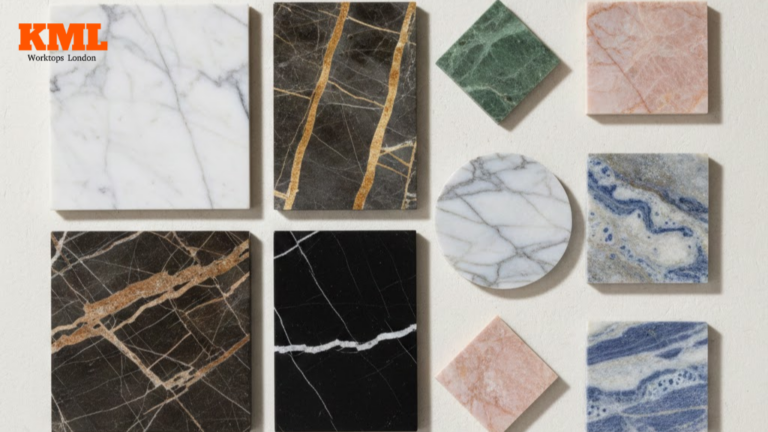
- Mineral impurities during the metamorphic process create marble's unique veining and colour variations, such as carbon forming grey or black marble and iron oxide producing pink, red, or yellow stone.
- Significant global sources of high-quality marble include Italy, India, Turkey, Greece, Spain, and China, often extracted from mountainous and geologically unstable regions.
- Marble remains a popular architectural and design choice due to its natural beauty, distinctive veining, high polish capability, and status as an enduring symbol of luxury.
As a material for construction, Marble has had great importance in the creation of many Architectural Styles and Sculptural Arts throughout history. Because of this strength, beauty and because it changes colours over time, Marble has been used as a building block for many of the most important architectural pieces in the world, including The Pantheon in Rome, Buckingham Palace in London, and The Taj Mahal in India. The name Marble is derived from the Ancient Greek word for “shine” or “mirror” (Marmaros), which refers to the property of its crystalline structure and natural lustre, and Linguistics experts believe that this term originates from earlier Mediterranean Language(s that used similar terms to describe Light-Reflective Stones.
Marble continues to be one of the most sought-after Natural Stone materials used in the creation of all forms of Construction and Design, and historically, it was used as an Ornamental Stone in all cultures that valued it for its ability to withstand the Elements, its strength, and exceptional beauty.
What is marble?
Marble is a metamorphic rock formed from sedimentary rocks, primarily limestone or dolostone. Unlike man-made materials, marble is created naturally within the Earth over extremely long periods, resulting in a stone with unique veining, colour variation, and crystalline structure.
How Is Marble Formed?

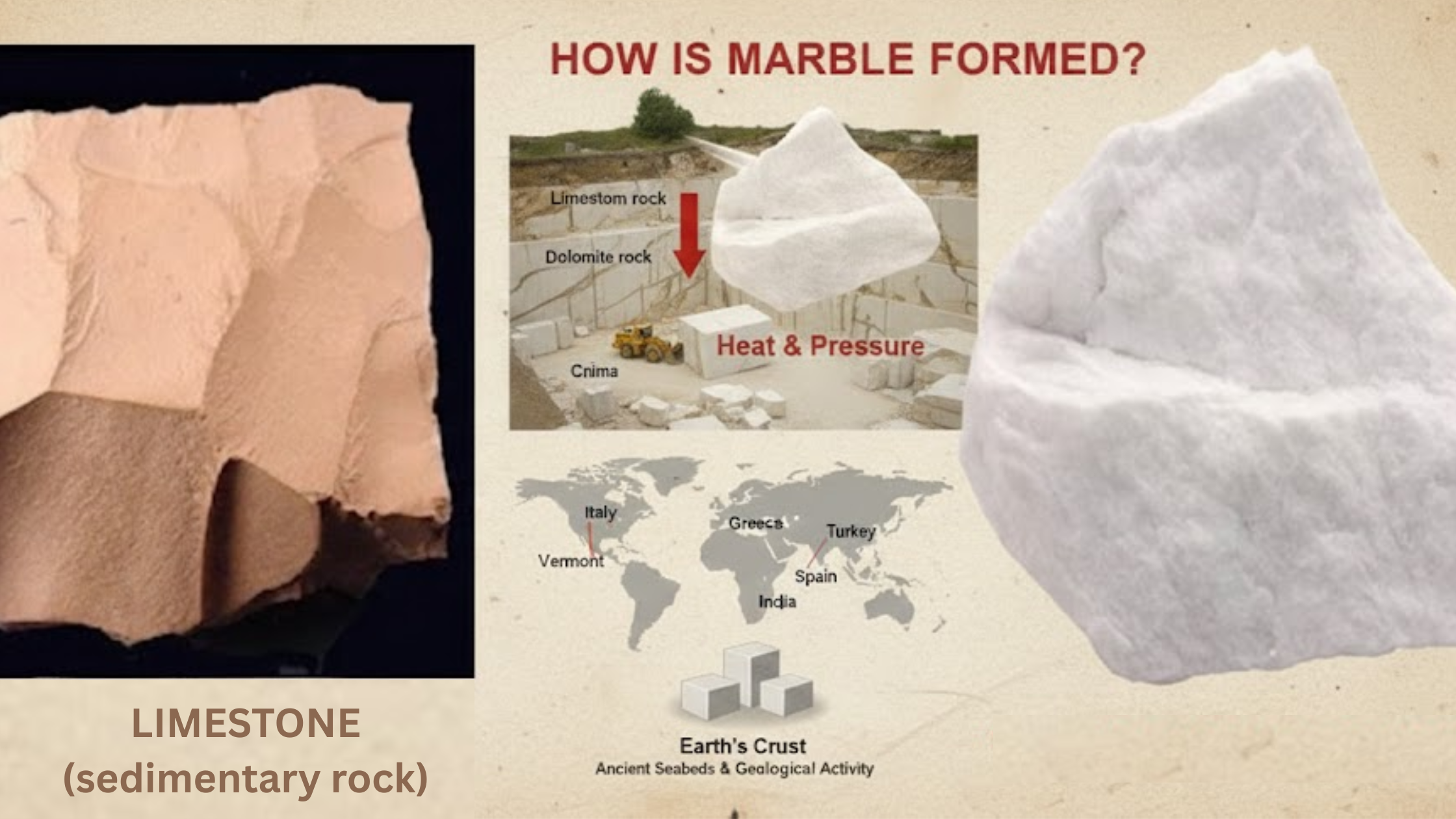
The process of Marble involves the physical transformation of limestone via Metamorphism. Metamorphism occurs when limestone is drawn down into the Earth and exposed to high-temperature environments and extreme pressures.
1. Origin as limestone
Marble is formed from a sedimentary rock called limestone. Limestone consists of shells and skeletons of marine organisms, as well as some sediment-rich deposits that have accumulated over millions of years on the ocean floor.
2. Heat and Pressure
The movement of Tectonic Plates causes limestone deposits to be thrust deeper into the crust; over thousands of years, intense heat and pressure change the structure of limestone without melting it.
3. Recrystallisation
The metamorphic process causes the calcite components of limestone to be changed into crystalline structures. Recrystallisation removes fossils and sedimentary layers from limestone. People can now see the smooth surfaces and solid unit of crystallised limestone, also known as Marble.
4. Formation of veining and colour
The appearance of Marble is the result of mineral impurities throughout the metamorphic process. Most White marble is almost entirely made of calcite; Grey/Black marble forms from Carbon, Green marble contains Serpentine, and Pink/Red/Yellow marble contains Iron oxide. All of these processes take millions of years to produce the natural and finite product known as Marble.
Where Does Marble Come From?

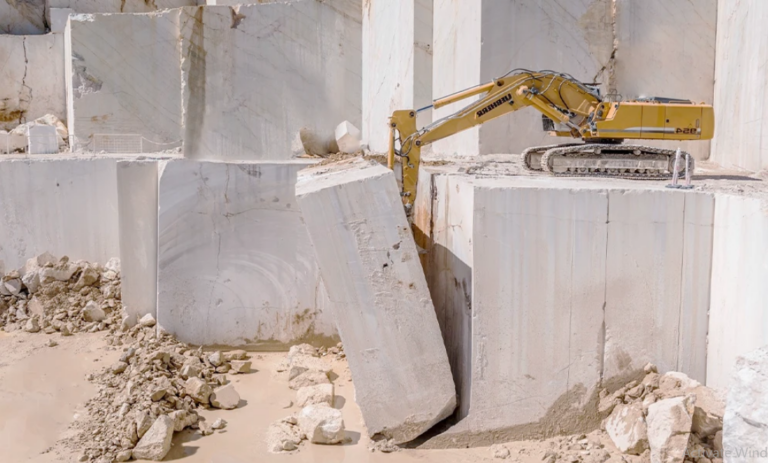
Marble is sourced from areas where limestone was deposited millions of years ago through the action of tectonic forces on the Earth’s crust. Generally speaking, the places where marble is sourced today tend to be mountainous and geologically unstable.
Some of the most significant marbles are produced in:
1. Italy – Italy produces some of the highest-quality white marbles available in the market today, such as Carrara, Calacatta, and Statuario, which are known for their dense, fine veining.
2. India – Makrana is one of the oldest known marbles in the world and was used to build the famous Taj Mahal.
3. Turkey – Turkey is one of the largest exporters of marble in the world. This country exports large amounts of marble with consistent quality in a variety of colours.
4. Greece – Greece has been a source of excellent quality white marble for many centuries. Ancient Greek buildings and sculptures were made with marble obtained from this region.
5. Spain – Spain has become known for its beige and cream-coloured marble, which is often used in modern architecture.
6. China – China produces large quantities of marble for both its own use and international markets.
Marble is shipped to cutting facilities after it is extracted. In addition to blocks, marble is cut into slabs, tiles, and custom architectural pieces.
Why Marble Remains A Popular Choice in the UK?
Marble is one of the most desirable materials today and has maintained its popularity due to the following:
- Natural beauty and distinctive veining.
- Ability to achieve a very high polish or hone finish.
- Long-lasting when appropriately sealed and properly emitted.
- Being an enduring representation of luxury and craftsmanship
Marble is commonly used as kitchen worktops, bathroom tops, flooring, wall cladding, stairs and bespoke items.
Where Can You Source Marble Near London?
Homeowners and designers in and around London do not have to find marble at international quarries; KML Worktops supplies top marble kitchen worktops in London using carefully selected slabs from worldwide sources, and fabricates and installed in London and across the UK. As a result, you can easily have world-class marble without having to deal with the complications of international sourcing.