Key Takeaways
- Worktop overlays are thin new surfaces placed directly on top of existing kitchen countertops to instantly transform the space without a full replacement.
- The installation process involves checking the base, choosing the material, building the overlay to order, and bonding it securely to the existing countertop.
- Various materials are available for overlays, including quartz, granite, laminate, solid surface or acrylic, and concrete.
- Key pros of using overlay worktops include being budget-friendly, providing a quick turnaround, offering a fresh aesthetic, and being more sustainable with less waste.
- Cons of overlay worktops include not being a permanent fix for major damage, featuring thinner material, offering less flexibility, and having heat and scratch sensitivity.
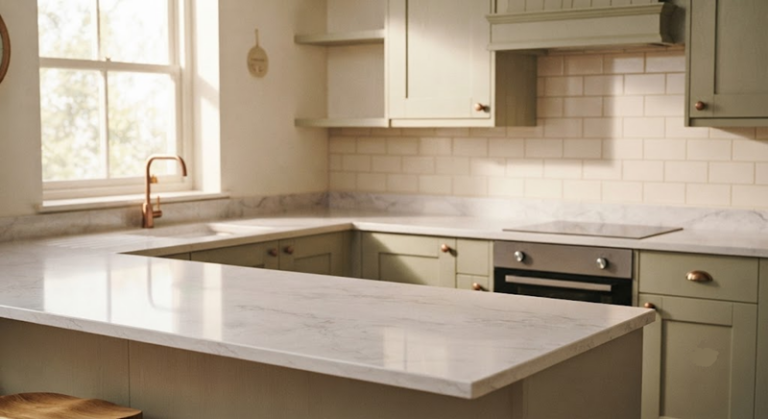
Dreaming of a kitchen makeover but not the cost, chaos, or downtime that comes with it? Here’s the secret: worktop overlays. These worktop covers are put right on top of your existing kitchen surface, instantly transforming your kitchen without replacing the worktop.
Whether you love sleek quartz, warm wood tones, or bold stone effects, overlay worktops for kitchens are a quick, eco-friendly, and affordable way to refresh your space — no major renovation required.
What are Worktop Covers?
An overlay worktop, also called a worktop cover, is a thin new surface of engineered stone, laminate, or concrete designed to sit on top of your existing countertop, provided it’s level and sound. In other words: a kitchen worktop cover. It is a clever shortcut to refresh your kitchen without ripping everything out.
You’re not replacing the whole base, you’re covering it. It gives your kitchen a fresh look, often at a lower cost and with less disruption than a full replacement.
What is the procedure for the overlay worktop?
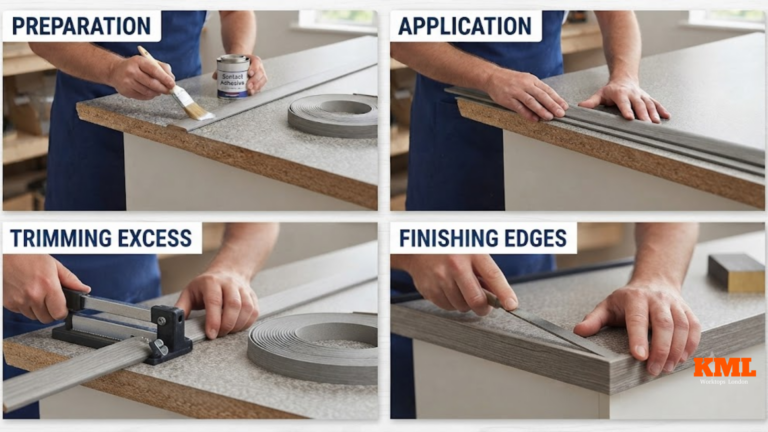
Here is a basic, step-by-step procedure:
Step 1: Make sure your current worktop base is level, sturdy, and free of water damage.
Step 2: The next step is to choose the overlay material, such as granite, quartz, acrylic, laminate, etc. You can also choose the colour, texture, and edge finish to match your kitchen’s look.
Step 3: After these steps are completed, the overlay is built to order in a workshop to fit your exact worktop shape. This includes shaping the corners and edges as well as cutting off areas for the sink, stove, and taps.
Step 4: It is fitted to the existing countertop using glue or bonding. In some cases, old material is removed or additional material is added for extra support.
Step 5: After installation, you can add finishing touches (joints, edges) and seal (if necessary) to make your new surface usable.
Types of Worktop Covers
Here are the main types of worktop overlays commonly available, and depending on your taste and price range, there are various kinds of overlays for kitchen worktops:
1. Quartz Overlays: Quartz is a super tough and scratch-resistant overlay which gives your kitchen a classy, stone look, and it is made from crushed stone mixed with resin. They’re thin sheets (about 1–2 cm) that sit right on top of your old countertop.
2. Granite Overlays: Granite overlays are just thinner than a full granite worktop and look gorgeous, it comes in a variety of natural patterns and are very durable, but sometimes it needs sealing to stop stains.
3. Worktop Laminate Covers: This is the most affordable worktop cover for UK homeowners and the easiest way to refresh your countertop. It’s basically a thin plastic laminate sheet glued over the old top. These overlays are easy to clean and come in tons of colours and styles.
4. Solid Surface Overlays or Acrylic: These overlays are made from acrylic resin mixed with minerals and give a super smooth and seamless finish. It looks modern, are easy to clean, and minor scratches can be buffed out.
5. Concrete Overlays: This is a thin layer of microcement or polymer concrete that’s applied right over your old countertop. It gives an industrial, stylish look and can be tinted to any colour. It does need sealing and occasional maintenance.
How Much Do Worktop Covers Cost?
One of the first questions most homeowners ask is: how much cheaper is this than a full replacement? Here’s a rough guide by material, based on typical UK installations:
| Overlay Material | Typical Cost (per m²) | Notes |
| Laminate | £150 – £250 | Most budget-friendly, DIY-friendly for simple runs |
| Solid Surface / Acrylic | £250 – £400 | Mid-range, professional fit recommended |
| Granite | £300 – £450 | Needs sealing, natural variation |
| Quartz | £400 – £500 | Closer to the price of full-slab quartz once you factor in plumbing changes |
| Concrete / Microcement | £200 – £350 | Price varies with finish and sealing needs |
A word of caution: the saving isn’t always as big as it looks. Once you factor in plumbing adjustments (see below), a tricky layout, or a premium finish, a quartz overlay can creep close to the cost of a full quartz worktop. If budget is the main driver, laminate overlays deliver the biggest saving by far.
For an exact price on your kitchen, get a free quote, and we’ll break down the numbers for your specific layout.
5 Pros of using overlay worktops for kitchens
- Budget-friendly: A worktop cover can cost less than a full countertop replacement because you skip removing the old layer and often pay less for labour and materials.
- Quick turnaround: Since you’re working on the existing base, installation can be faster and cause less mess and disruption.
- Fresh aesthetic: It gives you a new look, modern finishes, stone-like textures, and quartz-style surfaces without full kitchen remodelling.
- Sustainable / less waste: Rather than tossing out the old worktop, you’re reusing it as the base. That means less landfill, fewer materials.
- Suitable for light refreshes: If your kitchen is mostly fine but the worktop is tired, an overlay is a good upgrade.
5 Cons of overlay worktops
- Not a Permanent Fix for Major Damage: If your old worktop is badly damaged (e.g., warped, rotten, or crumbling), an overlay is more of a cosmetic cover-up. It won’t solve the underlying issue. Over time, the problem could resurface.
- Seams can let water in over time: Because an overlay is fitted in sections, it has joins, and they tend to land exactly where you don’t want them: around the sink, the tap, and the dishwasher. If water works its way into a seam and reaches the chipboard or MDF base underneath, that base can swell. Once it swells, the overlay lifts and bubbles, and there’s usually no fixing it short of removing the whole thing. A full slab worktop is one continuous piece around the sink, so there’s no seam for water to find in the first place.
- Less flexibility: If you want major changes, such as depth changes, sink relocation, major cut-outs or full removal of old cabinets, then an overlay won’t achieve everything. You can’t always change the shape or layout of your counters. Overlays are made to fit the worktop you already have, so if you want to change the design (like add curves or extensions), it’s not ideal.
- Heat & Scratch Sensitivity: Materials like laminate and acrylic overlays can get damaged by heat or sharp knives
- Raised height can mean plumbing changes: Adding 6–8mm of material on top of your existing worktop sounds trivial, but it lifts the height of your worktop, sink, and tap. That can mean adjusting pipework, refitting the sink, or changing how appliances sit underneath, turning what looked like a one-day job into something more involved.
Overlay vs Full Worktop Replacement
| Overlay / Worktop Cover | Full Replacement | |
| Upfront cost | Lower (laminate £150–250/m², quartz £400–500/m²) | Higher, but not always by much once plumbing is factored in |
| Fitting time | Often a single day | Templating visit, then a fitting day |
| Mess & waste | Minimal — old worktop stays in place | Old worktop removed and disposed of |
| Seams at the sink | Yes — a known weak point | No — continuous surface |
| Edge profiles | Limited to basic profiles | Full range (square, bullnose, ogee, and more) |
| Worktop height | Raised — may need plumbing tweaks | Stays at standard height |
| Fixes underlying issues | No — it’s a cosmetic layer | Yes — the base is addressed before fitting |
| Typical lifespan | 5–10 years (laminate), 15–20 years (stone) | Decades, with proper care |
If your existing worktop is sound and you want a quick, budget refresh, the overlay column wins. If you’re planning to stay long-term or want a worktop that’ll outlast the kitchen around it, full replacement is the better long-term investment.
When to use worktop covers
Here are scenarios where a worktop overlay makes a lot of sense:
- Although your current worktop is flat, free of significant cracks, and still fits well, it has become discoloured, damaged, or out of style, and you would like to replace it.
- You’re working with a tighter budget and want a cost-effective upgrade rather than a full replacement.
- You want to minimise disruption (for example, you need your kitchen back in service quickly).
- You’re staying in your home for now and want an improved look without the full investment of a full kitchen remodelling.
- You’re comfortable with the limitations: maybe you’re okay with slightly visible seams or less heavy thickness, and you’re fine choosing a durable but not ultra-premium overlay material.
Conversely, you might skip an overlay and go full replacement if:
- The old worktop base is damaged, warped or unstable.
- You want to change the surface dimensions (e.g., extend the worktop, change the drop, relocate sink/hob).
- You want the highest-end materials (big slab thickness, seamless look) and are focused on maximum resale value.
- You plan for a long-term stay and want a “forever” surface rather than a refresh.
Other Ways to Refresh a Worktop
An overlay isn’t the only way to update a tired worktop without a full replacement. Depending on your budget and how long you need the fix to last:
- Worktop paint or resurfacing kits: the cheapest option, but purely cosmetic and not built for heavy daily use.
- Vinyl wrap: inexpensive and quick, but prone to peeling at edges and around the sink, and doesn’t handle heat. Fine as a short-term or rental fix.
- Compact laminate: thinner and more affordable than a full slab, with better heat and scratch resistance than standard laminate overlays.
- Solid surface (e.g. Corian, Hi-Macs): seamless and non-porous, a step up from acrylic overlays if budget allows.
Of these, a good-quality overlay is the most durable no-replacement route, but it’s worth knowing what else is out there before you commit.
Is an overlay worktop right for you?
Not sure if a worktop overlay is the right fit for your kitchen? Let’s keep it simple, if you tick most of these boxes, it probably is!
- If your existing surface is flat, sturdy, and free from big cracks, it’s a great base for a kitchen worktop cover. No need to rip everything out!
- Maybe your counters look a little tired or outdated, but the rest of your kitchen still works for you. That’s exactly when overlay worktops for kitchens shine, they give your space a fresh, modern look without the chaos of a full remodel.
- Full replacements can take days and cost a small fortune. A worktop cover can usually be installed in a day or two and is much more budget-friendly.
- Overlay worktops sit right on top of your existing one, so they’re not as thick as a solid stone slab. Most people can’t even tell the difference, but it’s good to know.
- If you choose a quality overlay material, from sleek quartz and granite looks to durable laminate designs, it will last for years and handle everyday kitchen life very easily.
If yes to most: go for a worktop cover/overlay. If no to some: consider full worktop replacement.
Conclusion
An overlay worktop or worktop cover is a smart, practical option for many kitchens. It bridges the gap between “my worktop looks old” and “I need a full kitchen rebuild”. It offers a fresh look, reasonable cost and quicker installation. But, like all solutions, it comes with trade-offs, especially around the condition of your base and the material used. Use it when your base is solid, your goal is refresh, not remodel, and you’re comfortable with the constraints. Skip it when you want full flexibility, a flawless premium finish, or you’re fixing structural issues anyway.
Frequently Asked Questions
Q1: Are overlay worktops any good?
A well-made overlay from a specialist is a genuine product, often backed by a warranty, and can look great and wear well, provided the base underneath is solid, dry, and level. Over a compromised or water-damaged worktop, it’s a much bigger gamble.
Q2: How much do overlay worktops cost?
As a rough guide, laminate overlays start around £150–250 per m², and quartz overlays run £400–500 per m². The final price depends on your kitchen’s layout and any plumbing changes needed for the raised height.
Q3: How long do overlay worktops last?
It varies with quality and the state of the base. Laminate overlays typically last 5–10 years; a good stone overlay on a sound worktop can last 15–20 years. A full quartz or granite worktop will usually outlast either by decades.
Q4: Can you fit an overlay on a damaged worktop?
No realy, the whole idea depends on the existing surface being flat, sturdy, and free of water damage. If the worktop underneath is failing, covering it over tends to store up problems rather than solve them.
Q5: Will an overlay affect my sink or plumbing?
Possibly, adding a few millimetres of thickness raises the sink and tap slightly, which can mean minor plumbing adjustments during fitting.
Q6: Can I install an overlay myself?
Laminate overlays can sometimes be DIY-friendly for simple, straight runs. Stone overlays (quartz, granite) are made to measure and almost always need professional fitting for a proper seal and finish.