
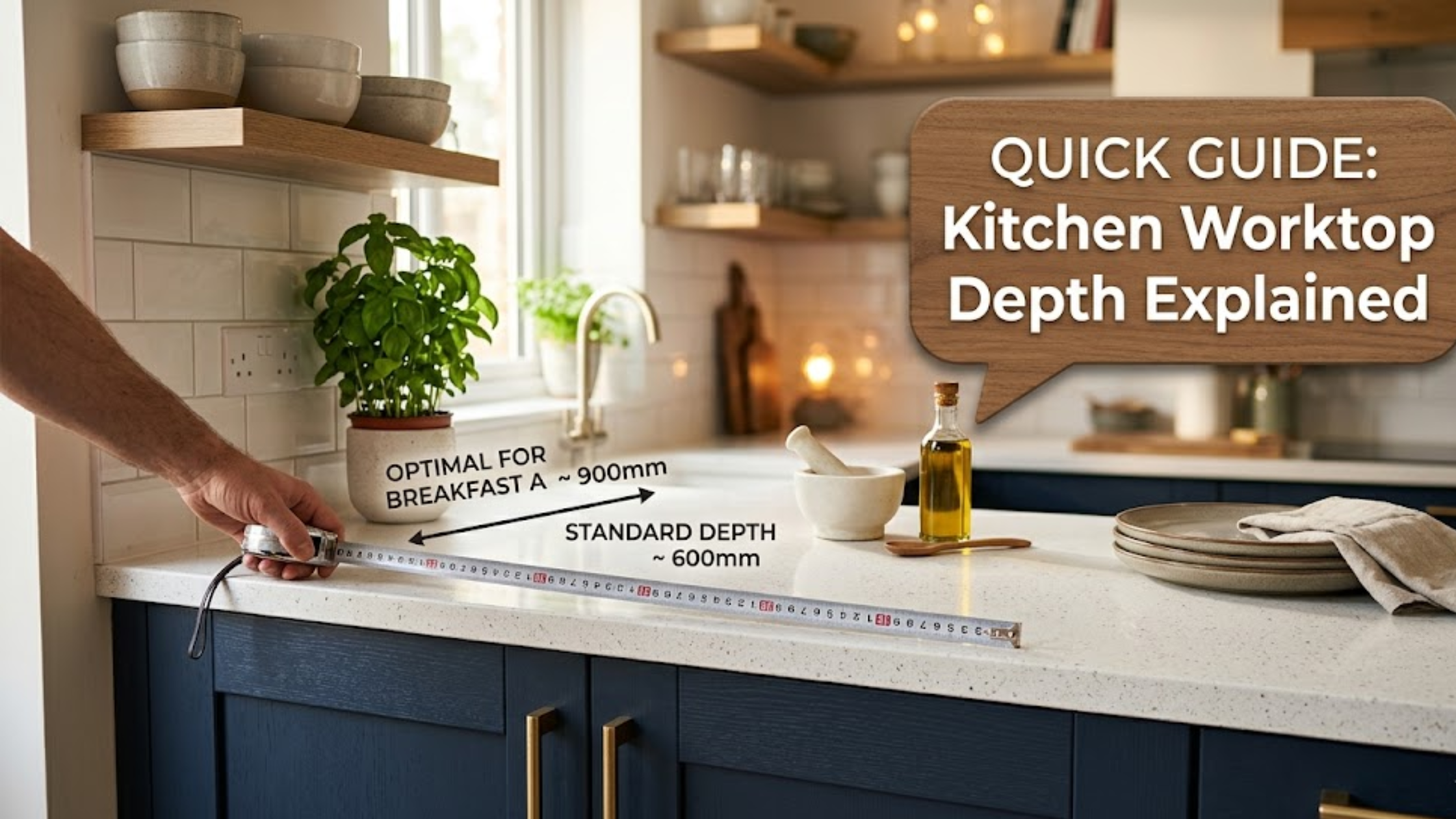
When planning or renovating a kitchen, it is easy to get caught up in choosing the right material or colour for your worktop. But one measurement that often gets overlooked until it is too late is kitchen worktop depth. Get this wrong and your worktop might not sit flush with your cabinets, leave awkward gaps, or simply not work with your appliances.
This guide covers everything you need to know about standard worktop depth in the UK, from the most common dimensions and how they relate to your base units, to specialist sizing for kitchen islands, breakfast bars, and compact spaces.
What Is Kitchen Worktop Depth?
Worktop depth refers to the measurement from the front edge of the worktop to the back wall, in other words, how far the surface extends from front to back. This is different from the length (how wide your run of worktops is) and the thickness (how deep the slab itself is from top to bottom).
Understanding depth is important because it determines how well your worktop fits over your base units and how much usable preparation space you have.
What Is the Standard Kitchen Worktop Depth in the UK?
The standard kitchen worktop depth in the UK is 600mm (60cm). This is the most widely used dimension and is designed to sit neatly over standard base cabinets, which are typically around 560mm deep.
However, many worktops are also manufactured at 635mm or 650mm depth. This slightly extra depth provides a useful front overhang of around 20–30mm over the cabinet face, which protects cabinet doors from spills and gives a clean, finished appearance.
Here is a quick summary of the most common standard worktop depths:
| Worktop Depth | Best For |
| 600mm | Flush fit over standard base units |
| 635mm | Compatible with all major cabinet brands, allows for slight overhang |
| 650mm | Extra prep space, generous overhang finish |
Why Is 600mm the Standard Worktop Depth?
The 600mm standard has developed in line with the dimensions of standard UK kitchen appliances. Most under-counter appliances, dishwashers, washing machines, fridge freezers, and integrated ovens, are built to 600mm wide and approximately 600mm deep. Worktops of the same depth allow everything to slot together seamlessly beneath one continuous surface.
Base cabinet units are typically manufactured at around 560mm deep. When a 600mm or 635mm worktop sits on top, it naturally creates a small overhang at the front. This overhang is intentional, it covers the cabinet door and provides a clean visual line, while also helping to catch crumbs and spills before they reach your cabinet fronts.
Kitchen Worktop Depth vs. Cabinet Depth: How They Relate
It is important not to confuse worktop depth with cabinet depth. Your base cabinets are generally shallower than your worktop, this is by design. Here is how the measurements typically stack up:
| Component | Typical Depth |
| Base cabinet carcass | ~560mm |
| Cabinet door (closed) | +18–22mm |
| Standard worktop | 600–650mm |
| Front overhang result | 20–40mm |
The slight overhang at the front is not just aesthetic, it also helps prevent water and debris from falling behind cabinet doors and provides a comfortable edge to grip when opening drawers.
Worktop Depth for Kitchen Islands
Kitchen islands require a different approach to depth. The standard worktop depth of 600mm is considered the minimum functional depth for a working island, any shallower and you lose meaningful preparation space.
For islands that double as a seating area or breakfast bar, you will need additional depth to accommodate an overhang. Most islands fall into one of these size categories:
| Island Use | Recommended Depth | Notes |
| Working island only | 900mm | Good prep space on both sides |
| Island with breakfast bar | 900–1200mm | Includes 250–300mm seating overhang |
| Large island with dining | 1200mm+ | Requires bracket or corbel support beyond 300mm |
Always allow a minimum of 1000mm of clear walkway space around all sides of your island, 1200mm is ideal in busier or family kitchens.
Understanding Worktop Overhangs
The overhang is the portion of the worktop that extends beyond the front edge of your base cabinets. There are two distinct types of overhang to be aware of:
Standard Installation Overhang
For standard base cabinet runs, an overhang of 20–40mm is typical. This covers the cabinet door thickness (usually 18–22mm) and provides a functional lip at the front. This modest overhang requires no additional support.
Breakfast Bar and Seating Overhang
Where a worktop extends to create seating, such as on an island or peninsula, a much deeper overhang is needed. The recommended overhang for comfortable seating is 250–300mm. This allows enough knee room for bar stools without requiring people to perch uncomfortably.
Key overhang guidelines to keep in mind:
- Maximum unsupported overhang for quartz and granite is 300mm
- Laminate worktops can extend up to 600mm unsupported
- Any overhang beyond 300mm on stone worktops requires brackets, corbels, or steel supports
- Overhang should not exceed 30% of the total worktop depth
Worktop Depth for Small and Galley Kitchens
In compact kitchens, every millimetre counts. If your kitchen is narrow or you are working with a galley layout, you may want to consider a shallower worktop to preserve movement space. Some worktops can be custom cut to reduce depth, and bespoke options are available from many UK suppliers.
That said, going significantly shallower than 500mm will limit your usable preparation space and may cause issues with appliance sizing. If a full 600mm depth is too much, consider opting for slimline appliances designed for narrow spaces rather than cutting your worktop depth dramatically.
How to Measure Kitchen Worktop Depth
Whether you are replacing an existing worktop or fitting one for the first time, accurate measurement is essential. Here is how to do it correctly:
- Start at the wall: Measure from the back wall (or the back of the cabinet) to the front edge of the cabinet
- Check for uneven walls: Account for any wall irregularities, walls are rarely perfectly straight, so measure at several points along the run
- Add your overhang: Add your desired overhang (typically 20–30mm) to the cabinet depth measurement
- Check existing worktops: If replacing an existing worktop, measure the existing worktop as your reference, but always double-check against your cabinets in case the old worktop was non-standard
- Islands need all-round measurement: For islands, measure the full cabinet footprint and then add the required overhang on all applicable sides
Standard Worktop Sizes at a Glance
As well as depth, worktops come in a range of lengths and thicknesses. Here is a summary of the key worktop dimensions you will encounter when shopping for a kitchen worktop in the UK:
| Dimension | Standard Range | Notes |
| Depth (standard) | 600–650mm | 600mm most common; 635mm highly compatible |
| Depth (island) | 900–1240mm | Larger sizes for seating/preparation |
| Length | 2000–4000mm | Typically sold in 3m lengths; custom available |
| Thickness | 20–40mm | 38mm most common; thinner styles increasingly popular |
Does Worktop Material Affect Depth Options?
The material you choose for your worktop can influence which depths are available off the shelf and what is achievable structurally:
- Quartz and granite: Available in standard depths of 600–650mm and larger island sizes up to 900mm or more. Very rigid, making it well suited to modest overhangs without extra support.
- Solid wood: Often available in slightly narrower standard depths (600–620mm). Solid wood expands and contracts with humidity, so a slightly wider worktop (635mm+) is often recommended to allow for any natural movement without the worktop pulling away from the wall.
- Laminate: Available in standard and island depths, typically 640–940mm for island-edged pieces. Laminate offers more flexibility for unsupported overhangs than stone.
- Solid surface (e.g. Corian): Available in similar depths to quartz. Seamless and repairable, but maximum unsupported overhang rules still apply.
Can Kitchen Worktops Be Cut to a Custom Depth?
Yes, most worktop materials can be cut down to a shallower depth if your kitchen requires it. This is particularly useful if your base cabinets are non-standard, or if you are fitting a worktop in a utility room, bathroom, or compact kitchen where the full 600mm is not appropriate.
Cutting a worktop to a custom depth is a straightforward process for a kitchen fitter, though the cut edge will need to be sealed or profiled depending on the material. For laminate and solid wood worktops, this is a common and inexpensive customisation. For quartz and granite, specialist tools are required, and the work should always be carried out by a professional stonemason.
Summary
Getting your kitchen worktop depth right is one of the most important practical decisions in any kitchen project. Here is a quick recap of the key points:
- Standard kitchen worktop depth in the UK is 600mm, with 635mm also widely used.
- Base cabinets are typically 560mm deep; the 20–40mm worktop overhang is intentional.
- Kitchen islands require a minimum depth of 900mm for functional work surfaces.
- Seating overhangs should be 250–300mm; anything beyond 300mm on stone worktops needs support.
- Worktops can be cut to custom depths to suit non-standard layouts.
- Material choice can affect which depths are available and what overhangs are structurally safe.
Whether you are fitting a simple run of cabinets or planning an elaborate island, understanding worktop depth will help you make smarter decisions, and avoid costly mistakes during installation.
Frequently Asked Questions
What is the standard depth of a kitchen worktop in the UK?
The standard kitchen worktop depth in the UK is 600mm, with 635mm also extremely common. Both dimensions are designed to fit neatly over standard 560mm-deep base cabinets while providing a small front overhang.
How deep are kitchen worktops for islands?
Kitchen island worktops start at a minimum depth of 900mm for a functional working surface. If the island includes seating, depths of 900–1200mm are typical, incorporating a 250–300mm seating overhang on one side.
How much overhang should a kitchen worktop have?
For standard base cabinets, a 20–40mm overhang is normal. For breakfast bars and seating areas, a 250–300mm overhang is recommended for comfortable knee room. Overhangs beyond 300mm on stone worktops require additional bracket or corbel support.
Can I get a worktop that is shallower than 600mm?
Yes. Worktops can be custom cut to shallower depths to suit non-standard cabinets or compact kitchen layouts. The cut edge will need finishing, and for stone worktops this must be done by a professional.
Why is my worktop deeper than my kitchen cabinets?
This is intentional. Base cabinets are typically 560mm deep, and a 600mm or 635mm worktop creates a deliberate front overhang. This overhang covers the cabinet door, catches spills and crumbs, and gives the kitchen a clean, professional finish.
