Key Takeaways
- Natural stone worktops are quarried directly from the earth, offering unique veining, mineral patterns, and organic beauty that adds character and value to a home.
- Engineered stone countertops are manufactured using crushed natural stone combined with resins and pigments, creating a dense, non-porous, and visually consistent material.
- Natural stone requires periodic sealing and careful maintenance with pH-neutral products to protect against moisture, staining, and surface damage.
- Engineered stone countertops demand minimal maintenance, do not require sealing, and offer excellent resistance to stains, scratches, and bacteria, though they are more sensitive to high temperatures.
- Choosing the right surface depends on lifestyle and design intent, with natural stone favoring individuality and luxury, while engineered stone prioritizes consistency, everyday durability, and ease of care.
Choosing the appropriate surface to use in the kitchen, bathroom or utility area is a long-term investment that directly influences aesthetics, durability and maintenance. Among the most common choices available today are natural stone worktops and engineered alternatives. Although both can be considered appealing to the eye and useful, their performance, composition, and maintenance vary considerably. These differences can be understood to make an informed decision.
The predicament that the homeowner encounters most of the time in KML worktops is whether they can be true to natural stone or whether they can be precise to the man-made composite materials. This guide will offer a broad comparison with the aim of finding the most appropriate choice for your space.
Understanding Natural Stone Worktops
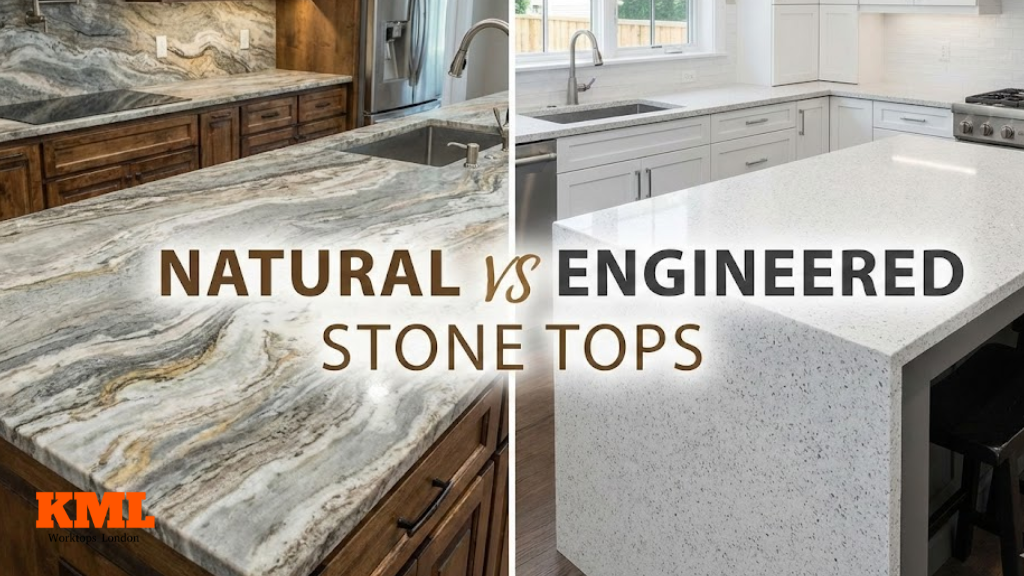
Natural stone worktops are quarried directly from the earth and cut into slabs for residential and commercial use. Some of the common ones are granite, marble, limestone, slate and quartzite. Every slab is created over millions of years, which makes a special veining, the patterns of the minerals and the variations of colours.
One of the defining characteristics of natural stone worktops is uniqueness. Each and every installation is unique, as the slabs are not alike. This variation in natural features provides depth and character to the property, tends to increase its value, and adds a classic touch.
Nevertheless, natural stone is porous by nature, to a greater or lesser degree. This means most natural stone worktops require periodic sealing to protect against moisture penetration, staining, and surface damage. These surfaces can be maintained and used to last a number of decades without a loss of appeal.
What Are Engineered Stone Countertops?
Engineered stone countertops are manufactured surfaces created using crushed natural stone (primarily quartz) combined with resins and pigments. This process produces a dense, non-porous material commonly referred to as composite stone.
Unlike natural stone worktops, engineered stone countertops are designed for consistency. Colour, pattern, and texture are governed when making, which enables consistency when it comes to seeking appearance on large installations. This predictability is especially advantageous in modern kitchen designs and trading settings.
Materials such as engineered granite replicate the appearance of natural granite worktops while offering enhanced resistance to staining and reduced maintenance requirements.
Aesthetic Considerations
When comparing natural stone worktops with engineered alternatives, aesthetics play a critical role.
Natural stone worktops offer organic beauty, irregular veining, and depth that cannot be perfectly replicated. These attributes are greatly appreciated in the old-fashioned, luxury and custom interiors when the individuality is considered.
Engineered stone countertops, by contrast, provide visual uniformity. They come in various colours and in solid colours as well as faint patterns that match the modern trend of interior. For homeowners seeking a clean and controlled design language, composite stone surfaces are often preferred.
Durability and Performance
The longevity is also differentiated by the type of material.
Natural stone worktops such as granite and quartzite are extremely hard and resistant to heat, making them ideal for high-use kitchens. Marbles and limestone are less rigid and are prone to etching by acidic elements; moreover, they are more resonant.
Engineered stone countertops are engineered for strength and daily practicality. Their non-porous composition provides good resistance to stains, scratches, and bacteria. Engineered surfaces are not as resistant to high temperatures, however, owing to the resin used, metallic and steel surfaces must be guarded against heat with the use of trivets.
Maintenance Requirements
A major point of difference between the two options is the maintenance.
Natural stone worktops require routine care, including sealing at intervals to maintain stain resistance and surface integrity. Washing should be done with neutral PH products so that the surfaces are not damaged.
Engineered stone countertops demand minimal maintenance. As a composite stone product, they do not require sealing and can be cleaned easily with mild soap and water. This makes engineered granite and similar materials particularly suitable for busy households.
Cost and Long-Term Value
The cost of natural stone worktops varies widely based on rarity, origin, and thickness. Though there are some competitively priced granites, the premium marble or exotic quartzite worktop may be a serious investment. Continuous sealing costs are also to be taken into consideration.
Engineered stone countertops generally fall within a mid-to-high price range. Though the initial price can be similar to the resources of the middle of the natural stone, the lack of maintenance in the long term is likely to be cost-effective in the long run.
Environmental Considerations
Natural stone worktops are composed of a single, natural material and can last for generations, reducing the need for replacement. Quarrying and transportation, however, cause an environmental impact.
Engineered stone countertops involve a manufacturing process, but many modern composite stone products incorporate recycled materials and adhere to low-emission standards. These are the innovations that can be used to lower the footprint on the environment and provide lasting performance.
Choosing the Right Option for Your Home
The decision between natural stone worktops and engineered alternatives depends on lifestyle, design intent, and usage requirements.
- For homeowners seeking individuality, luxury, and natural aesthetics, natural stone worktops remain unmatched.
- For those prioritising consistency, ease of maintenance, and everyday durability, engineered stone countertops offer a practical solution.
- In outdoor or high-heat environments, natural stone worktops are generally more suitable than resin-based composite stone.
Conclusion
Both natural stone worktops and engineered stone countertops offer distinct advantages. Natural stone delivers authenticity, longevity, and timeless appeal, while engineered granite and other composite stone surfaces provide modern performance and convenience.
Since KML Worktops specialises in providing surfaces, clients of this company are professionally guided towards making the right choice depending on their functional requirements and design preferences. Whether choosing the organic elegance of natural stone worktops or the precision of engineered stone countertops, the right choice balances beauty, performance, and long-term value.